Blogs / Trendy Tech Talks / Advantages And Disadvantages Of The Internet Of Things Iot
Blogs / Trendy Tech Talks / Advantages And Disadvantages Of The Internet Of Things Iot

Primebook Team
06 Jun 2024
Advantages And Disadvantages Of The Internet Of Things Iot
Table of Contents
- Introduction
- What is IoT
- Advantages of the Internet of Things (IoT)
- Disadvantages of the Internet of Things (IoT)
- Future of IoT
- Conclusion
- Frequently Asked Questions
Introduction
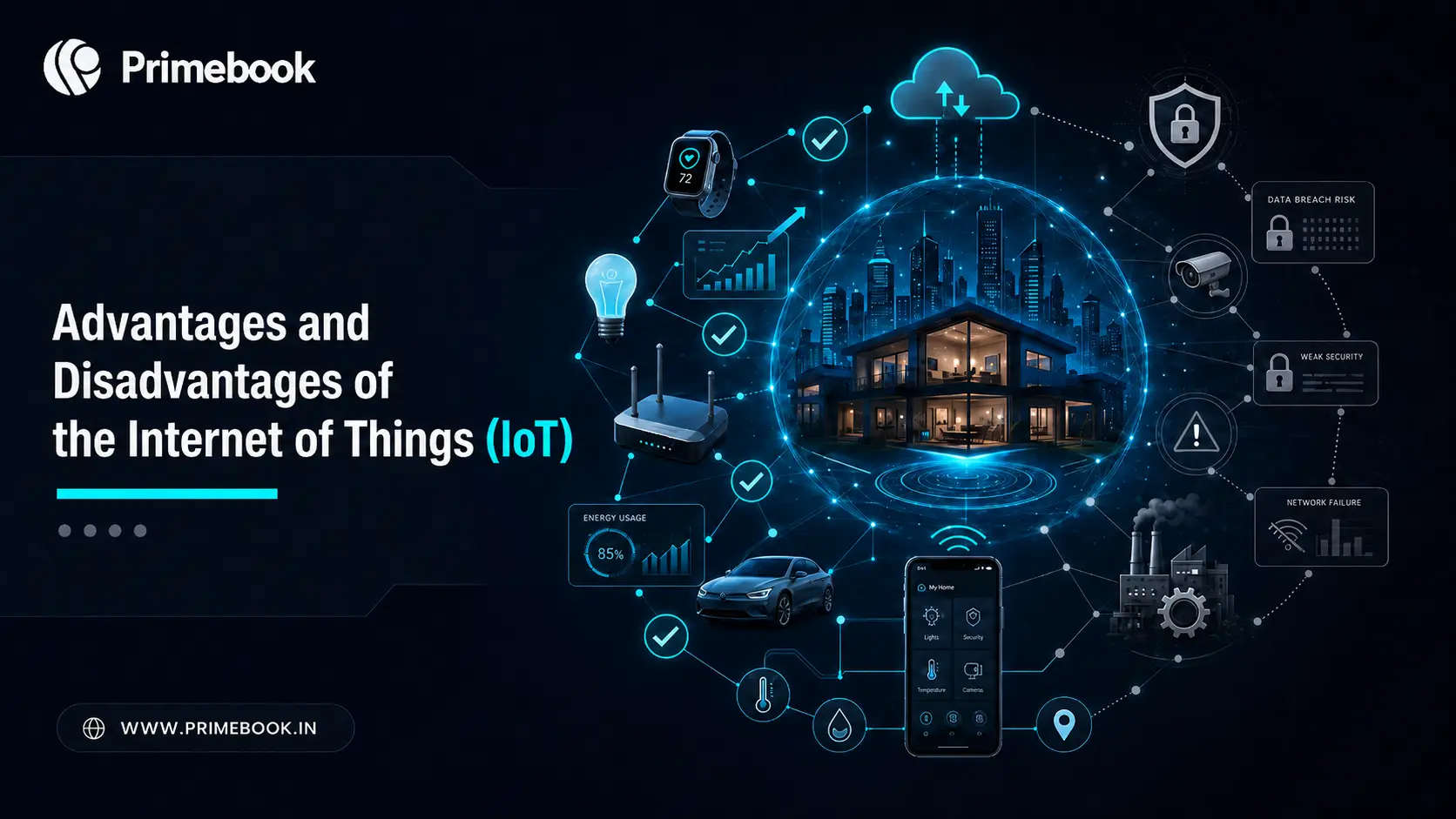
The Internet of Things (IoT) has quietly become part of everyday life. Whether it is a smartwatch tracking your health, a security camera sending alerts to your phone, or a smart appliance that can be controlled remotely, connected devices are now embedded across homes, workplaces, healthcare, transportation, and manufacturing.
This growing network of connected devices brings obvious benefits, such as greater convenience, automation, and real-time insights, but it also introduces new challenges around privacy, security, interoperability, and dependence on technology. Understanding both sides of IoT is becoming increasingly important as more people and businesses adopt connected systems.
This blog explores what IoT is, its key advantages and disadvantages, and how the technology is expected to evolve in the years ahead.
What is IoT: A Brief Note!
Internet of Things, or IoT, refers to a network of physical devices such as appliances, vehicles, sensors, and everyday objects that are connected through the internet. Using embedded software, sensors, and connectivity, these devices can collect data, communicate with each other, and respond to their surroundings with minimal human intervention.
Instead of operating in isolation, IoT devices continuously exchange data with each other or with cloud-based systems. A fitness band can sync health data to your phone, a smart thermostat can adjust temperature automatically, and connected industrial sensors can alert engineers before equipment fails. This constant flow of data is what makes IoT systems more responsive and efficient. The term was first coined in 1999, but the earliest glimpse traces back to the 1982 Coca-Cola vending machine at Carnegie Mellon University, which was connected to the internet for remote monitoring.
One of the biggest factors accelerating IoT adoption today is the expansion of 5G networks. Faster speeds, lower latency, and the ability to connect far more devices simultaneously make real-time IoT applications more practical across industries. Industry estimates project India's 5G IoT market to grow rapidly through 2030, highlighting the growing adoption of connected devices across industries such as manufacturing, healthcare, logistics, and smart cities.
Advantages of the Internet of Things (IoT)
Some of the key advantages of IoT are:
- Automates repetitive tasks and improves operational efficiency.
- Improves resource management by enabling real-time tracking of assets, inventory, and equipment.
- Many modern IoT devices are designed with energy-saving features, helping reduce power consumption during periods of inactivity.
- IoT gives you the power to control and monitor devices and systems remotely, with far more precision.
- Enables predictive maintenance by identifying issues before equipment fails.
- Supports scalable deployments and can reduce operating costs by improving resource utilisation.
These advantages translate differently across industries, depending on how IoT is deployed. In India, Industrial Automation and Transportation lead as the largest IoT application segments, valued at roughly USD 30 billion and USD 32 billion, respectively. That is where you see the sharpest gains: reduced downtime in factories, optimised routes and fuel use in logistics, and predictive maintenance in fleets. Industry trend reports increasingly highlight AI and machine learning as core components of modern IoT platforms, enabling predictive maintenance, anomaly detection, and automated decision-making instead of simple monitoring.
The table below summarises where IoT delivers the clearest wins in 2026 in India.
| Domain | Primary Advantage | Real-World Signal |
|---|---|---|
| Manufacturing | Predictive maintenance, reduced downtime | Factories increasingly using connected equipment and smart monitoring systems |
| Transportation | Route and fuel optimisation | Connected fleet management and intelligent traffic systems |
| Homes | Remote control, automation, energy saving | Growing adoption of smart home ecosystems |
| Healthcare | Continuous monitoring, faster response | Wearables and remote patient monitoring |
| SMEs | Low-code dashboards, quick automation | Automated order processing and inventory alerts |
Disadvantages of the Internet of Things (IoT)
Despite its many benefits, IoT also introduces challenges that organisations and users need to address as connected systems become more widespread.
- One of the biggest disadvantages of IoT is the potential for data breaches or hacking.
- Privacy issues around the collection and use of personal information remain a serious concern in IoT.
- Dependency on technology, and the chance of system failures cascading across connected devices, is significant.
- Limited standardisation and compatibility among devices is another persistent IoT problem.
- Regulations and legal frameworks around IoT are still catching up, leaving uncertainty in application.
- IoT setups involve technical complexity and higher maintenance requirements than standalone devices.
The scale of adoption sharpens these risks. With India's IoT market projected to reach around USD 114.53 billion by 2035, the attack surface widens proportionally: more devices, more endpoints, more places a single vulnerability can propagate. Edge computing helps by processing sensitive data closer to the source, but as the 2026 India IoT trends analysis flags, it also shifts security responsibility onto distributed edge nodes that are harder to monitor uniformly. Similarly, the rise of low-code and no-code IoT platforms lowers the entry barrier for Indian SMEs, but quick-build deployments without governance planning become brittle as they scale.
Future of IoT
In the years ahead, IoT-based technologies are set to offer far more advanced services and reshape how we live day to day. Smart speakers, connected vehicles, smartwatches, smart home appliances, industrial sensors, and connected healthcare devices are already becoming commonplace; what is now maturing is IoT stitched into medicine, agriculture, automobiles, manufacturing, and homes as coordinated systems rather than isolated gadgets.
The regional pull is strong. The Asia-Pacific IoT market is forecast to grow from USD 218.57 billion in 2025 to USD 392.76 billion by 2030 at a CAGR of 12.4%, placing India inside a rapidly digitising neighbourhood. As billions of connected devices come online, researchers are exploring new approaches to device identity, interoperability, and secure communication to support the next generation of IoT systems. Sustainability is now sitting alongside performance as a design constraint. Edge computing, machine learning, and artificial intelligence continue to play an increasingly important role in IoT, while blockchain is being explored for specialised use cases such as secure device identity and data integrity. Ultimately, the winning deployments would be those that reduce energy consumption, keep data local where possible, and remain intelligible to the humans running them.
Also Read:
- Discover The Top IoT Applications
- What is IoT Industry 4.0 and How it Matters?
- The Rise of Smart Classroom: IoT-Enabled Learning Spaces!
Conclusion
IoT empowers smart devices to talk to each other and to the wider internet, and by 2026 that conversation has moved from novelty to infrastructure. The real question for users and organisations is no longer whether IoT will become more common, but how its benefits will continue to be balanced with concerns around security, privacy, and interoperability as connected systems become part of everyday life.
Frequently Asked Questions
What is the biggest advantage of IoT in 2026?
The biggest advantage is that IoT now pairs with AI to predict problems, not just report them. That shift means fewer breakdowns, better energy use, and faster decisions in factories, transport, and even homes.
What is the biggest disadvantage of IoT?
Security and privacy remain the top risks. More connected devices mean a wider attack surface, and India's fast-growing IoT device base makes governance, updates, and standardisation urgent rather than optional.
Is 5G important for IoT growth in India?
Yes. India's 5G IoT segment is projected to grow at a CAGR of 52.8% through 2030, enabling low-latency use cases like real-time monitoring, autonomous fleets, and dense industrial deployments that legacy networks could not support well.
Should small businesses in India adopt IoT now?
Small businesses can start with low-code IoT platforms that offer dashboards and automation without heavy engineering. The caution is to plan for security and scalability from day one, since quick-build systems can become fragile as data and devices multiply.
Editorial Transparency: Primebook's editorial team uses a combination of human expertise, research, and AI-powered tools to create and refine content. Every article is reviewed and validated by our team before publication to ensure accuracy, clarity, and usefulness for readers.


 Related Blog