Future Trends and Innovations in Android Laptops Technology

Table of Contents
- Introduction
- The Rise of Android as a Laptop OS
- Smooth Multitasking & Hybrid Computing
- Smarter Hardware Optimisation
- Expanding App Ecosystem
- Voice Interaction and AI Integration
- Long Battery Life
- Conclusion
- FAQs
Introduction
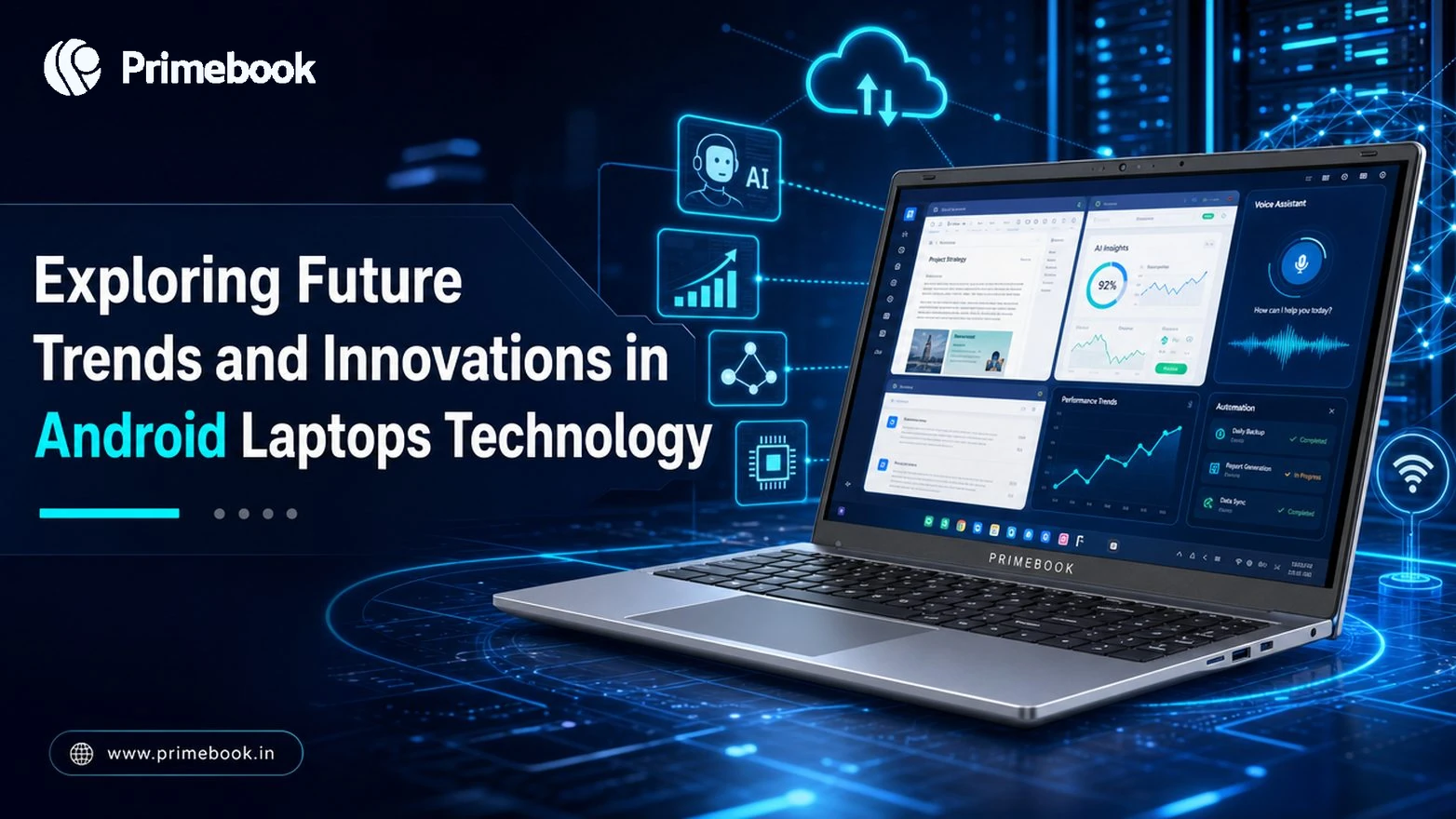
Android laptops have evolved from a niche category into a growing alternative for everyday computing. Improvements in desktop interfaces, AI integration, ARM processors, mobile connectivity, and application support are shaping the next generation of Android-powered laptops. This article explores the major trends and innovations expected to define Android laptop technology in the years ahead.
The Rise of Android as a Laptop OS
Launched initially for phones, Android has become the dominant global mobile OS. Its open-source Linux-based platform offers manufacturers more flexibility than Apple's closed iOS ecosystem, and that same flexibility now fuels its expansion into laptops as a lightweight alternative to Windows.
Asia Pacific held 35.2% of global laptop revenue in 2025, the largest regional share, and Omdia reports that India's PC market reached a record high in 2025, despite rising device costs. As more users look for efficient and value-oriented computing devices, Android laptops are emerging as a compelling alternative for everyday productivity.
Android's flexibility has also enabled companies to build operating systems specifically for laptop use. Primebook's PrimeOS, based on Android 15, is designed for larger screens with features such as desktop-style multitasking, keyboard and trackpad optimisation, multi-window support, and an interface tailored for productivity. Rather than simply scaling a mobile operating system to a larger screen, this approach focuses on creating a seamless Android experience built specifically for laptop users.
At the same time, another significant industry development is Google's decision to bring ChromeOS and Android closer together, with the aim of creating a more unified desktop experience across Android-powered devices. This reflects the broader direction in which Android computing is evolving.
Smooth Multitasking & Hybrid Computing
Multitasking has become one of the defining strengths of modern Android laptops. Features such as split-screen, multi-window support, and seamless app switching already allow users to work across multiple applications simultaneously. This matters most for the workflows Indian users actually run: a student toggling between a PDF, a lecture video, and notes; a freelancer moving between Docs, a design tool, and client chats. Better multitasking transforms Android laptops into genuine workhorses rather than large-screen phones.
The next stage of innovation lies in improving multitasking across hybrid computing platforms. Instead of being limited to a single operating system, users increasingly expect one device to access different computing environments based on the task at hand. For example, an Android-native laptop can handle everyday apps locally while providing access to Windows or Linux environments through Cloud PC when desktop-specific software is needed. As hybrid computing evolves, switching between these environments is expected to become faster, more seamless, and better integrated into the overall user experience.
Smarter Hardware Optimisation
One of the biggest shifts in Android laptops is the focus on delivering better performance through software and hardware optimisation rather than relying solely on increasingly powerful components. Modern ARM processors, faster storage technologies, and operating systems designed specifically for laptop hardware are enabling smoother everyday performance while improving boot speeds, application responsiveness, and overall system performance.
Future innovation is likely to focus less on increasing hardware specifications and more on improving how processors, storage, operating systems, and AI work together to deliver faster, more responsive everyday computing.
Expanding App Ecosystem
The Android ecosystem already offers millions of applications, but many were originally designed for smartphones. One of the biggest innovations in Android laptops is the growing focus on applications built specifically for larger screens, with interfaces optimised for keyboard and trackpad input, multi-window workflows, and desktop-style productivity rather than touch-only interaction.
Looking ahead, users can expect to see more laptop-first Android applications and applications built specifically for Android-based laptop operating systems. From professional productivity tools and creative software to development environments and advanced file management utilities, future Android laptop software is expected to take fuller advantage of the capabilities offered by desktop-oriented Android operating systems.
Also Read:
Voice Interaction and AI Integration
Artificial intelligence is becoming a core part of Android laptop experiences, with voice interaction making it easier for users to perform tasks without navigating multiple menus or applications. Rather than using voice only for searches or basic commands, modern AI systems are increasingly capable of understanding natural language, maintaining context, and assisting users across a wider range of everyday computing tasks.
The next phase of innovation lies in making these AI experiences more capable and seamless. As these AI systems become more capable, users will increasingly be able to use voice or natural language to trigger complete workflows across applications, files, browsers, cloud services, and even different computing environments from a single interface. The focus is no longer on adding AI to laptops, but on making AI a more intelligent execution layer that simplifies how users interact with their devices.
Long Battery Life
Battery life is expected to remain one of the biggest advantages of Android laptops. Power-efficient ARM processors, combined with operating systems optimised specifically for laptop hardware, are already enabling all-day usage on many devices without significantly increasing battery size.
The next stage of innovation will focus on making battery management more intelligent rather than simply adding larger batteries. AI-assisted power management, adaptive resource allocation, and tighter hardware-software integration are expected to optimise power consumption based on how users work, helping extend battery life while maintaining consistent performance throughout the day.
Conclusion
The future of Android laptops is not about replacing traditional PCs. It is about building a computing experience that feels more natural to the next generation of users. In a market like India, where smartphones introduced millions to the internet, Android already represents a familiar way of interacting with technology. Extending that experience to laptops lowers the learning curve while making productivity more accessible.
As Android laptop technology continues to evolve, innovation will be driven not just by faster hardware or smarter AI, but by systems that adapt to how people already learn, work, and create. Rather than expecting users to change the way they compute, the next generation of Android laptops will increasingly evolve around the way users compute.
Also Read:
FAQs
Is Android officially coming to laptops in 2026?
Yes. Google confirmed at the Qualcomm Snapdragon Summit that ChromeOS and Android will merge into a unified desktop-ready Android experience, with OEMs expected to ship devices on this stack by 2026.
Are Android laptops good for real productivity work?
es. Modern Android laptops support multi-window multitasking, keyboard and trackpad input, desktop-style interfaces, and an expanding range of productivity applications, making them suitable for study, work, and content creation.
How do Android laptops compare to Windows laptops in the same price band?
Android laptops are designed to deliver efficient performance on modest hardware through tighter hardware-software optimisation. While Windows laptops may offer broader support for specialised desktop software, Android laptops prioritise simplicity, responsiveness, and battery efficiency for everyday computing.
Do Android laptops work offline in India?
Yes. Most Android laptops support offline use for installed applications, allowing users to continue working without an internet connection. Cloud-based features and online services become available whenever connectivity is restored.
What kind of battery life should I expect from an Android laptop?
Well-optimised Android laptops deliver 8 to 14 hours of real-world use on a single charge, thanks to power-efficient ARM processors paired with system-level battery tuning. Actual runtime depends on screen size, brightness, and workload.
Editorial Transparency: Primebook's editorial team uses a combination of human expertise, research, and AI-powered tools to create and refine content. Every article is reviewed and validated by our team before publication to ensure accuracy, clarity, and usefulness for readers.