Blogs / Student's Corner / Sarv Shiksha Abhiyan (SSA): India's Flagship Universal Education Program
Blogs / Student's Corner / Sarv Shiksha Abhiyan (SSA): India's Flagship Universal Education Program

Primebook Team
09 Jan 2025
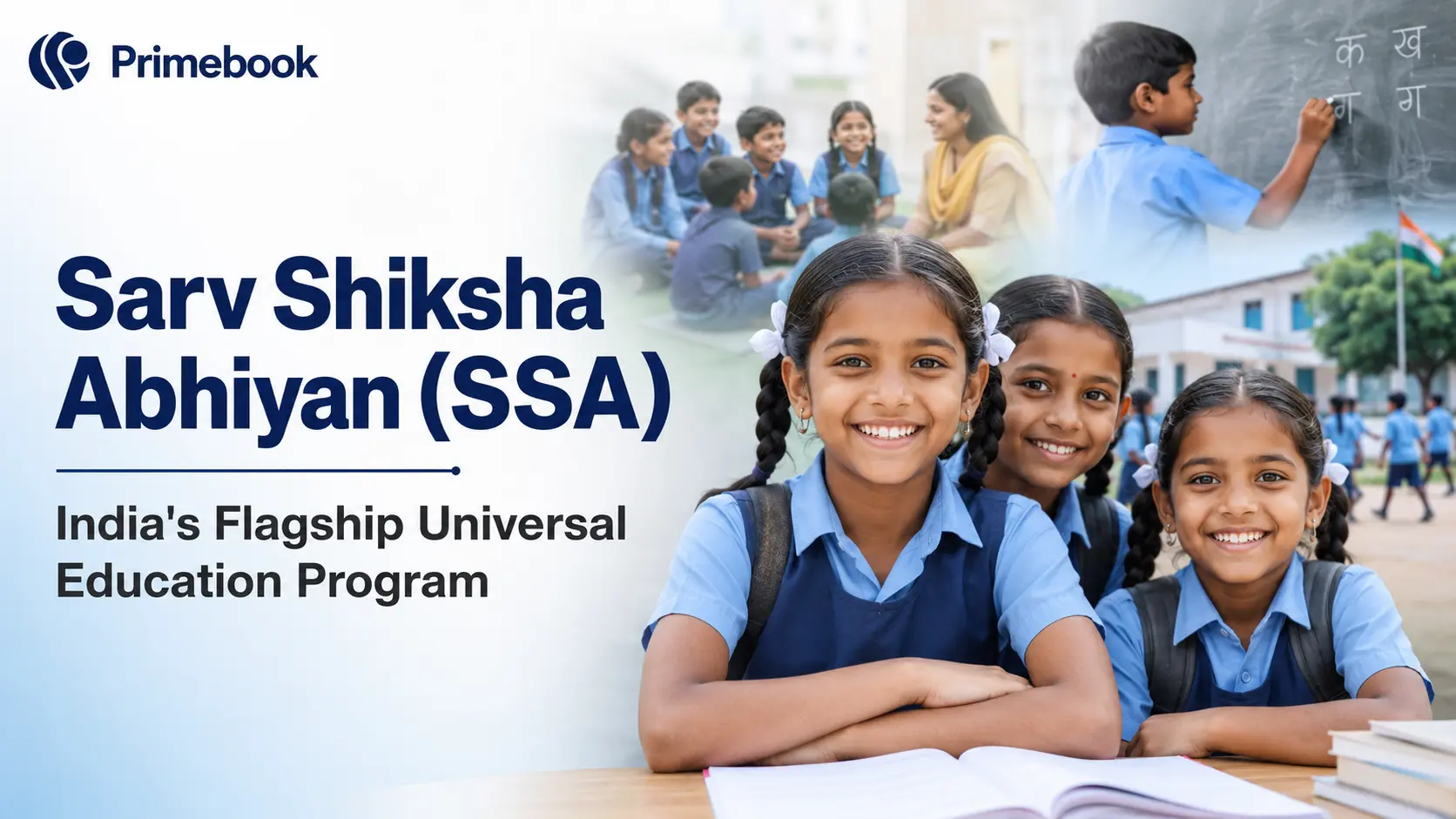
Sarv Shiksha Abhiyan (SSA): India's Flagship Universal Education Program
Table of Contents
- Introduction
- Overview of the Sarv Shiksha Abhiyan (SSA)
- Primary Objectives of the Sarv Shiksha Abhiyan
- Key Initiatives Supporting SSA
- SSA and the Confluence of Various Ministries and Schemes
- Conclusion
- Frequently Asked Questions
Introduction
By the late 1990s, India had significantly expanded access to schools, but challenges such as low enrolment, inadequate infrastructure, teacher shortages, and high dropout rates continued to prevent many children from completing elementary education. To address these issues, the Government of India launched the Sarv Shiksha Abhiyan (SSA) in 2001 as a comprehensive mission to achieve Universal Elementary Education for all children aged 6 to 14 years. Since 2018, SSA has been subsumed into the broader Samagra Shiksha scheme, covering school education from pre-school to Class XII, and its elementary education initiatives continue under this integrated framework. Let's understand how the programme works and what it has achieved.
Overview of the Sarv Shiksha Abhiyan (SSA)
The Sarv Shiksha Abhiyan is an umbrella programme pioneered by former Prime Minister Atal Bihari Vajpayee, originally anchored by the then Ministry of Human Resource Development (MHRD), now renamed as the Ministry of Education. It is run by the central government and state governments in partnership. After the 86th Constitutional Amendment Act, which inserted Article 21A into the Constitution, the primary goal of Sarv Shiksha Abhiyan, to provide free and compulsory education to children between the ages of 6 and 14 years, became a Fundamental Right. The central monitoring portal for SSA, 'ShaGun', was developed by the Ministry of Human Resource Development with support from the World Bank.
During its implementation as a standalone scheme, SSA provided free education and essential schooling support, including uniforms and textbooks, to children. It also focused on strengthening school infrastructure and improving teacher capacity. The scale of impact was significant: elementary school enrolment expanded from 18.79 crore to 19.67 crore children during SSA implementation, and by 2015-16 the Gross Enrolment Ratio at the primary level had reached 99.21%, indicating near-universal access.
Primary Objectives of the Sarv Shiksha Abhiyan
The primary objectives of SSA were to ensure equitable access to elementary education, improve learning quality, strengthen school infrastructure, and build teacher capacity. The functions of SSA are divided into three categories: infrastructural objectives, human resource objectives, and quality improvement objectives.
| Objective Category | Key Goals |
|---|---|
| Infrastructural | Open schools in areas without proper schooling infrastructure; strengthen current facilities by adding classrooms, washrooms, and clean drinking water; provide textbooks and uniforms free of cost to all children. |
| Human Resource | Improve the teacher-to-student ratio in schools; add teacher-training provisions and resources; empower the overall pedagogical and academic structure at the grassroots level. |
| Quality Improvement | Include life skills and extra-curricular components in learning; focus on education of girl children and specially-abled children; bridge the digital divide by strengthening computer literacy. |
These focus areas have produced measurable movement on the ground. Under SSA, the average annual dropout rate at the primary level declined from 6.76% in 2009-10 to 4.13% in 2014-15, while the transition rate from primary to upper primary rose from 85.17% to 90.14%, showing gains in retention alongside access.
Key Initiatives Supporting SSA
SSA was supported by several complementary initiatives and programmes:
- The Padhe Bharat Badhe Bharat programme aims to empower students of Classes I and II with better reading and writing skills, cultivating early literacy habits.
- Shaala-siddhi, the School Standard Evaluation Programme, supports proper implementation of SSA by assessing school standards across the country.
- The Swachh Vidyalaya programme ensures proper maintenance of schools, including clean drinking water, sanitation, and hygiene standards.
Inclusion has been a defining thread across these sub-programmes. By 2015-16, SC children accounted for 19.79% of total elementary enrolment, ST children 10.35%, and the share of Muslim children rose from 12.50% in 2010-11 to 13.80%. The Gender Parity Index also improved to 0.93 at primary and 0.95 at upper-primary level, showing that girls' enrolment had nearly caught up with boys under the programme.
SSA and the Confluence of Various Ministries and Schemes
Considering the vast goals of the scheme, SSA brings together multiple authorities and initiatives run by the central and state governments to improve schooling in India, under the umbrella of Universal Education. The Ministry of Health and Family Welfare (MoH&FW) takes care of ensuring regular health check-ups in schools, while the Ministry of Education facilitates the proper functioning of the PM POSHAN Scheme (formerly the Mid-Day Meal Scheme) across the country and takes care of the implementation of SSA principles in the National Institute of Open Schooling as well. The implementation of SSA in Integrated Child Development Services (ICDS) is coordinated with the Ministry of Women and Child Development (MWCD).
This layered coordination is what allows a mission of this scale to run. Detailed district-level planning formats track Blocks, Block Resource Centres, Cluster Resource Centres, villages, and disaggregated data on enrolment, GER, NER, dropout, repetition, completion, and transition, enabling evidence-based micro-planning that still underpins Samagra Shiksha's implementation in 2026.
Conclusion
More than two decades after its launch, the significance of Sarv Shiksha Abhiyan lies not only in expanding access to education but also in demonstrating how coordinated policy, institutional support, and sustained public investment can reshape a country's elementary education system at scale.
Also Read:
- Schemes for Free Education by The Government of India
- Central government scheme for free coaching for SC and OBC students
- Adult Literacy Program in India
Frequently Asked Questions
Why was Sarv Shiksha Abhiyan merged into Samagra Shiksha?
Sarv Shiksha Abhiyan was merged into Samagra Shiksha to create a single, integrated school education programme that enables better coordination, planning, and resource utilisation across all stages of schooling.
How did Sarv Shiksha Abhiyan improve access to education for girls?
Sarv Shiksha Abhiyan improved girls' access to education by supporting girl-focused initiatives such as the National Programme for Education of Girls at Elementary Level (NPEGEL) and Kasturba Gandhi Balika Vidyalayas (KGBVs), alongside efforts to reduce gender disparities in enrolment, attendance, and retention.
What is the difference between Sarv Shiksha Abhiyan and the Right to Education (RTE) Act?
The Right to Education (RTE) Act is the legal framework that guarantees every child's right to free and compulsory elementary education, whereas Sarv Shiksha Abhiyan (SSA) was the Government of India's flagship programme for implementing that right on the ground.
What role did teachers play in the Sarv Shiksha Abhiyan?
Teachers were central to the success of the Sarv Shiksha Abhiyan. Alongside recruiting additional teachers to improve the teacher–student ratio, the programme focused on continuous teacher training, capacity building, and academic support through Block Resource Centres (BRCs) and Cluster Resource Centres (CRCs). These initiatives aimed to improve classroom teaching quality, strengthen learning outcomes, and ensure consistent implementation of elementary education standards across schools.
Editorial Transparency: Primebook's editorial team uses a combination of human expertise, research, and AI-powered tools to create and refine content. Every article is reviewed and validated by our team before publication to ensure accuracy, clarity, and usefulness for readers.


 Related Blog