Shiksha Co Pilot Generative Ai Digital Assistant Government Of Karnatakas New Initiative To Support Teachers

Table of Contents
- Introduction
- What is Shiksha Co-Pilot (Generative AI Digital Assistant)?
- Features of Shiksha Co-Pilot
- Pilot Scale and Rollout in Karnataka
- How Shiksha Co-Pilot Works Technically
- Conclusion
- FAQ
Introduction
Preparing lesson plans, designing classroom activities, and adapting teaching materials for students at different learning levels takes significant time, especially in government schools where teachers often manage large classes and multiple responsibilities. UNESCO's State of the Education Report for India 2021: No Teacher, No Class highlighted the challenges of teacher availability, deployment, and workload in Indian schools, reinforcing the need for tools that can reduce planning effort while supporting classroom teaching.
Against this backdrop, the Karnataka government has stepped forward with a research initiative called "Shiksha Co-pilot", formally launched on 18 October 2024 at Vidhana Soudha by the state's School Education Minister. Built by Microsoft Research India's VeLLM platform in partnership with the Sikshana Foundation, it is a generative AI digital assistant designed to help government school teachers draft lesson plans, activities, quizzes, and grade-appropriate teaching resources.
What makes the project particularly relevant in 2026 is not just the technology, but the pedagogical intent behind it. This is an AI designed to assist teachers with curriculum planning rather than a student-facing chatbot. Let us look at what Shiksha Co-Pilot actually does, how it is being rolled out across Karnataka, and why it matters for the broader conversation on AI in Indian education.
What is Shiksha Co-Pilot (Generative AI Digital Assistant)?
Shiksha Co-Pilot is a generative AI-based assistant built primarily to serve the pedagogical needs of teachers in Karnataka's government schools. The stated goal, as articulated by the state's Minister of School Education and Literacy, is to improve learning outcomes by helping teachers create personalised, curriculum-aligned resources for students at different levels.
Currently, Shiksha Co-Pilot supports Classes 5 to 10 across Mathematics, Science, English, and Social Science in both Kannada and English mediums. It helps teachers generate curriculum-aligned lesson plans and classroom resources for different learning levels across supported subjects.
Features of Shiksha Co-Pilot
| Feature | What It Does |
|---|---|
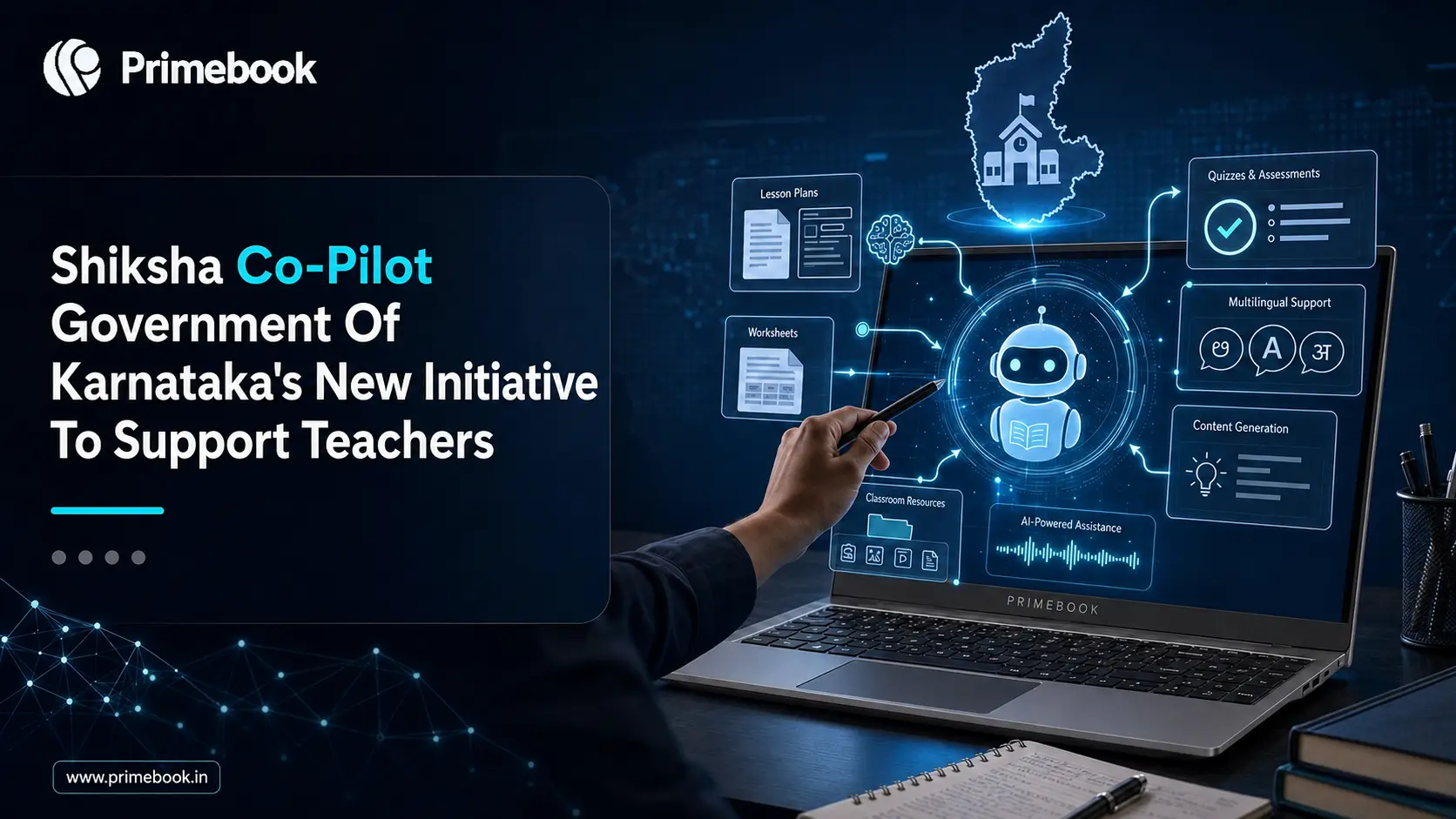
| Lesson plan generation | Creates full lesson plans in minutes, aligned to the Karnataka state curriculum for Classes 5-10 |
| Interactive resources | Curates topic-based activities, short videos, quizzes, and assessments dynamically |
| 5Es pedagogical model | Structures teaching around Engage, Explore, Explain, Elaborate, Elevate |
| Bilingual support | Works in both Kannada and English, matching Karnataka's classroom reality |
| Two chatbot modes | One for syllabus-specific queries, another as a general educational assistant for teachers |
| Low-friction access | Accessible via WhatsApp, Telegram, and web, allowing teachers to use it on commonly available smartphones and computers. |
| Curriculum indexing | Generates responses using Karnataka's curriculum and learning resources rather than generic internet content |
The design choice worth noting is that the platform supports teachers rather than replacing them. It reduces the mechanical work involved in lesson preparation, allowing more time for classroom instruction and student engagement.
Pilot Scale and Rollout in Karnataka
The first phase of Shiksha Co-Pilot supports 1,000 government school teachers from 750 schools, spread across every educational district in Karnataka and covering both urban and rural regions. A peer-reviewed research preprint documents that the assistant was deployed in classrooms between December 2024 and March 2025, providing early evidence from real classroom deployments rather than only a launch announcement.
The workflow itself runs in two phases: a Curation Phase, where expert teachers work alongside the AI to prepare and review lesson plans in Kannada and English, and a Distribution Phase, where these curated plans reach classroom teachers who can further customise them for their own students. This two-tier design is what keeps quality control tight even as scale grows.
How Shiksha Co-Pilot Works Technically
Underneath the interface, Shiksha Co-Pilot is built on VeLLM, a Microsoft Research India platform, and uses large language models with Retrieval-Augmented Generation (RAG). RAG matters here because it lets the AI ground its answers in Karnataka's actual curriculum documents rather than generating open-ended, generic content. When a teacher asks for a lesson on photosynthesis for Class 8, the system pulls context from the relevant textbook and syllabus before drafting.
The programme runs as a research collaboration between the Sikshana Foundation, Microsoft Research India, and the Department of School Education and Literacy, Government of Karnataka, with support from Microsoft India's CSR arm. As the pilot progresses, its broader adoption will depend on the outcomes of classroom evaluations and future decisions by the participating organisations.
For a wider view of how AI is reshaping Indian classrooms, see Artificial Intelligence (AI) in Education.
Also Read:
- Disruptive Technology in Education: A Comprehensive Guide!
- Adaptive Learning Technology All You Need To Know
Conclusion
Technology rarely transforms education on its own; the biggest gains usually come from improving the everyday work that happens before students enter the classroom. By focusing on lesson preparation, curriculum support, and classroom planning, Shiksha Co-Pilot highlights a quieter but potentially more scalable use of AI. Its long-term significance will depend not only on the technology itself, but on whether it can make teaching more effective without making it more complicated.
FAQ
Is Shiksha Co-Pilot available to every government school in Karnataka?
No. The initiative is currently being implemented as a pilot programme involving selected government schools. Any wider rollout will depend on the findings from the pilot and future decisions by the Karnataka government and project partners.
Why does Shiksha Co-Pilot use Karnataka's curriculum instead of general AI knowledge?
Shiksha Co-Pilot has been developed specifically for Karnataka's government schools, where teachers follow the state's prescribed curriculum. Using Karnataka's syllabus allows the assistant to generate lesson plans, activities, and assessments that match what teachers are expected to teach, instead of producing generic content or material aligned with a different state's curriculum.
Can Shiksha Co-Pilot be adapted for other Indian states?
Potentially, yes. While Shiksha Co-Pilot has been developed around Karnataka's curriculum, the underlying approach of combining AI with state-specific syllabi could be adapted for other states by integrating their respective curricula and teaching frameworks.
Is Shiksha Co-Pilot free for teachers?
There is no indication that participating teachers are required to pay to use Shiksha Co-Pilot during the current pilot programme. The initiative has been introduced as a government-supported pilot, and no subscription or usage fee has been announced.
Does Shiksha Co-Pilot replace teachers?
No. Every AI-generated resource goes through a Curation Phase where expert teachers review and refine it in English and Kannada before distribution.
Editorial Transparency: Primebook's editorial team uses a combination of human expertise, research, and AI-powered tools to create and refine content. Every article is reviewed and validated by our team before publication to ensure accuracy, clarity, and usefulness for readers.