Blogs / Student's Corner / B.Sc. vs BCA: Which Course to Choose After 12th
Blogs / Student's Corner / B.Sc. vs BCA: Which Course to Choose After 12th

Primebook Team
05 May 2026
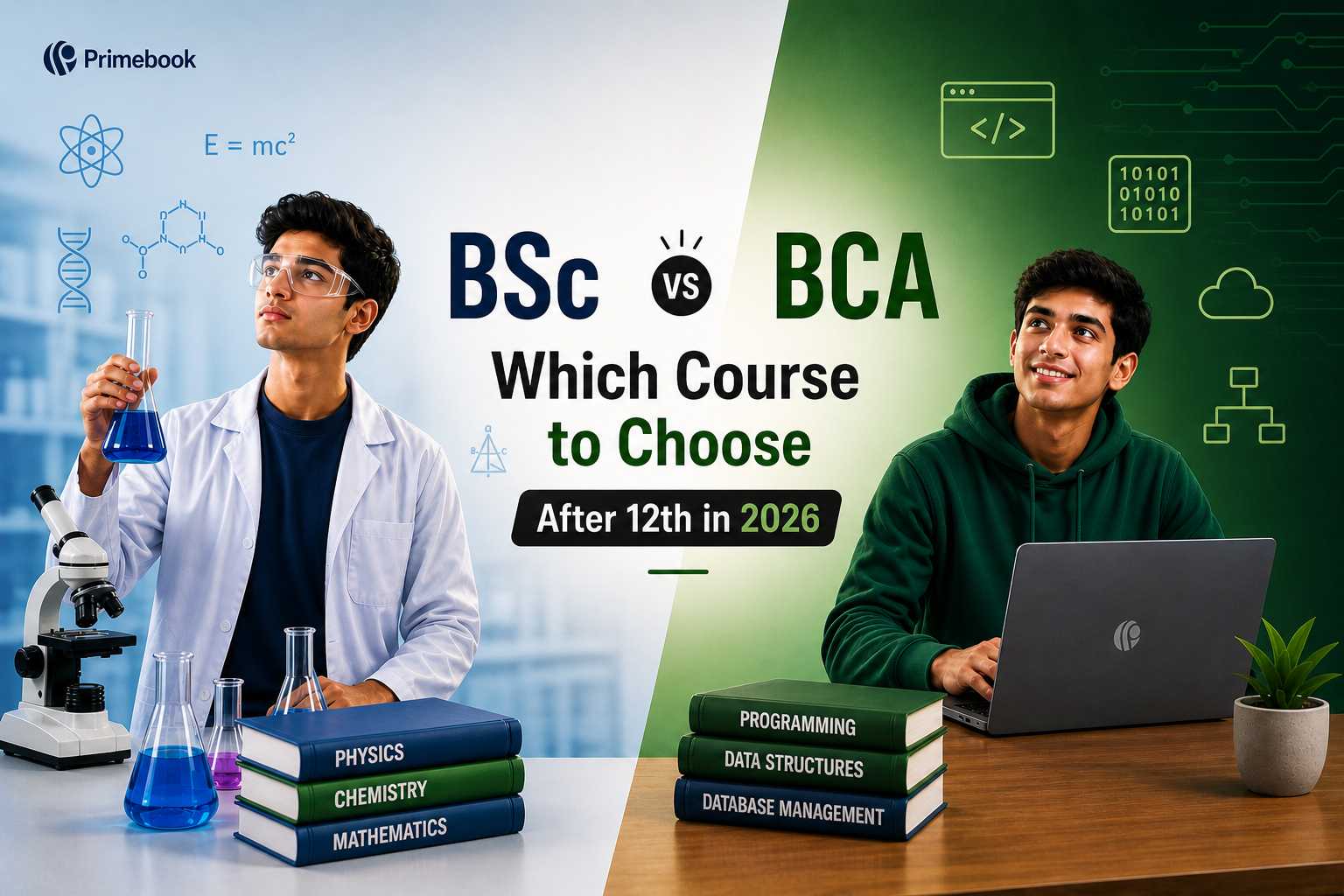
B.Sc. vs BCA: Which Course to Choose After 12th
Choosing between B.Sc. Computer Science and BCA after Class 12 is rarely a question of which degree is "better". It is a question of how you approach solving problems in computing, what kind of work you want to do, and how the path fits your long-term direction. Most students decide based on cut-offs, college reputation, or what their friends are picking. That is where the decision starts feeling unclear later, because both degrees lead to overlapping careers but build very different skill foundations.
The Indian tech ecosystem is expanding fast. According to IBEF, the Indian IT industry is projected to reach $350 billion by 2030, which means demand will exist for both science-led and application-led graduates. The real question is not which course gets you a job. It is the course that matches how you actually like to think and work.
What B.Sc. CS and BCA Actually Mean in 2026
B.Sc. in Computer Science is a three-year science degree that treats computing as a discipline rooted in mathematics, logic, and theory. The curriculum usually pulls from physics, statistics, discrete maths, and core CS subjects like data structures, operating systems, and computer architecture. The intent is to build a deep conceptual foundation, not just teach you how to use software.
BCA, or Bachelor of Computer Applications, is also a three-year degree but built around the application layer of computing. It focuses on programming languages, web development, database management, software engineering practices, and increasingly, modern areas like cloud and AI tooling. BCA is designed to prepare students for industry roles faster, with less weight on pure theory and more on building working systems.
Both degrees are recognised by UGC, both lead to postgraduate options like MCA or M.Sc., and both eventually connect to similar career paths. The difference is in how each course approaches the subject, not in the doors it opens.
Also Read: Why is an Android laptop better than Windows for College Students?
The Core Difference: Theory-First vs Application-First
The common belief is that B.Sc. is "harder" and BCA is "easier". That framing misses the point. The real difference is in execution style. BSc trains you to understand why a system works the way it does. BCA trains you to build something that works within a system. Neither is superior. They serve different ways of thinking.
A BSc student spends more time on mathematical reasoning, algorithm analysis, and theoretical models. This is useful if you want to go into research, advanced engineering, data science, or fields where deep understanding matters more than shipping speed. A BCA student spends more time writing code, building applications, and working with frameworks that are actively used in industry. This is useful if you want to enter the workforce quickly, freelance, or build products.
What most students hit later is not about the course itself, but about fit. A theory-loving student stuck in a heavily application-driven BCA programme feels under-challenged. An application-driven student in a maths-heavy B.Sc. programme feels disconnected from real work. Choosing well means knowing which mode of learning keeps you engaged for three years.
Also Read: Top 10 Engineering Colleges in Bangalore
Also Read: Best Courses After 12th Science in India 2026
B.Sc. Computer Science vs BCA: Quick Comparison
Before looking at career paths in detail, here is a side-by-side view of how the two courses actually differ on the parameters students care about most.
| Factor | B.Sc. Computer Science | BCA |
|---|---|---|
| Maths Requirement | High | Low to Moderate |
| Entry Requirement | Often PCM preferred | Commerce + Arts also allowed |
| Best Colleges Type | Universities | Private colleges, universities |
| Time to Job Readiness | Slower (needs depth) | Faster (practical skills) |
| Higher Studies Path | Strong (MSc, research) | MCA / job-first approach |
| Salary (Starting) | ₹3-6 LPA | ₹3-6 LPA |
Also Read: Best Android App to Learn Coding for Free
Career Paths After Each Course
Career outcomes overlap more than students expect, with both degrees feeding into the same job market. According to NASSCOM, India's technology industry continues to face a demand-supply gap in emerging digital skills, particularly in areas such as AI, machine learning, and data analytics. Recruiters increasingly prioritise demonstrable skills like coding ability, project work, and problem-solving over the degree label itself. That said, the typical trajectories do differ.
Common Roles for B.Sc. CS Graduates
- Data analyst and data science associate
- Research assistant in academic or corporate R&D
- Systems engineer and infrastructure roles
- Higher studies in CS, AI/ML, or computational fields
- Quantitative analyst in fintech
Common Roles for BCA Graduates
- Software developer and full-stack engineer
- Web and mobile application developer
- QA and testing engineer
- Database administrator
- Freelance developer and product builder
The truth most career counsellors miss: a BCA graduate with strong projects on GitHub and consistent output will outperform a B.Sc. graduate with only academic marks, and vice versa. The degree opens the door. What you build during the three years decides where you actually go.
Students working on coding side-projects, internships, or freelance gigs benefit from a workspace tuned for sustained execution. A reliable computing setup that supports development environments, browser-heavy research, and remote learning matters more than the brand of laptop.
Also Read: Best Laptop for Multitasking In India 2025: Primebook 2
How to Choose Between BSc CS and BCA
Most students choose between B.Sc. and BCA based on cut-offs and parental advice. A more useful approach is to look at how you actually engage with computing right now.
If you enjoyed mathematics in Class 11 and 12, find satisfaction in working out problems on paper, and feel curious about how things work under the surface, B.Sc. Computer Science aligns better. The course will feel like an extension of how you already think. You will also find the maths-heavy semesters less draining than those who entered without that foundation.
If you learn best by doing, prefer building over theorising, and have already tried writing small programmes or designing pages, BCA suits your wiring. The application-led structure rewards students who want to ship work, even imperfect work, rather than perfect their understanding before acting.
Three honest questions to sit with:
- When you hit a problem, do you reach for first principles or for a working example to copy and adapt?
- Do you want to spend your twenties going deeper into one field through a postgraduate path, or entering work and learning on the job?
- Are you comfortable with sustained mathematical reasoning, or does it drain you?
The answers will not give you a verdict, but they will tell you which course will feel like flow rather than friction.
Also Read: Top 10 Science Colleges in Ahmedabad
To conclude, one difference that rarely gets talked about is what each course allows you to ignore. A B.Sc. in Computer Science programme forces you to engage with concepts you might not immediately see the use of, but that later become hard to bypass. A BCA programme lets you move faster by focusing on application, but also leaves more of the deeper layers optional.
That tradeoff matters more than it seems. Over time, what you were required to learn and what you were able to skip start to shape the kind of problems you can handle without going back and relearning from scratch.


 Related Blog