Blogs / How To / Google's 8 Newest AI Tools in 2026
Blogs / How To / Google's 8 Newest AI Tools in 2026

Primebook Team
22 Sep 2026
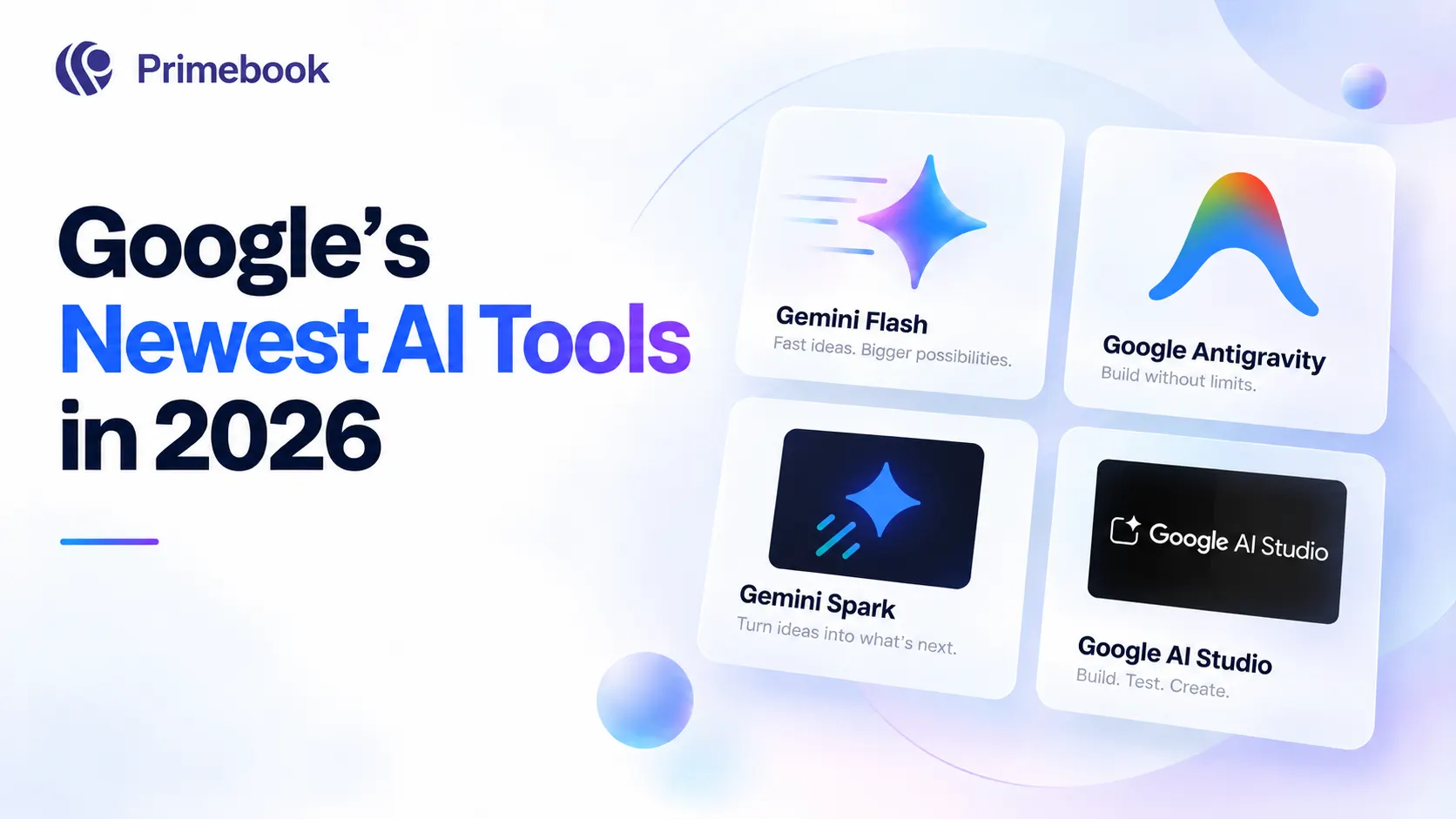
Google's 8 Newest AI Tools in 2026
Introduction
Students often hear a new Google AI name long before they know what it is for. A model gets announced, screenshots circulate, and by the time you look it up you are not sure whether it is a chatbot, a coding platform, or a video editor. That gap between knowing an AI name and knowing what to use it for is what this guide is designed to close.
This guide breaks down eight of Google's latest AI tools in 2026: what each one does, where it lives, who can access it, and what kind of academic or creative work it suits. No speculation about future features, no ranking of which one is "best".
What Changed at Google in 2026
The shift this year is less about smarter answers and more about where AI sits. Google's Flash models have moved rapidly from Gemini 3.5 Flash to 3.6, 3.7 and now 3.8 Flash, while tools such as Spark and Antigravity are pushing AI further into agents and workflows. This means AI can now appear directly inside tools you already use, rather than requiring you to open a separate AI product.
Another notable change is multilingual access. For students working across Hindi, Tamil, Bengali, Marathi and English, broader language support can make AI tools more useful for everyday study and research.
The 8 Tools at a Glance
| Tool | What it does | Where you access it | Access status |
|---|---|---|---|
| Gemini 3.5 Flash | Fast model for agentic and coding tasks | Google AI Studio, Gemini API, Android Studio, AI Mode in Search | Available across supported Google products; access varies by product |
| Gemini 3.6 Flash | More efficient workhorse model for coding, knowledge work and multimodal tasks | Gemini app, Gemini API and supported Google AI products | Available to users through supported Google products; access varies by product |
| Gemini 3.7 Flash | More capable workhorse model for coding, agents and complex workflows | Gemini API, Gemini app and supported Google AI products | Available through supported Google products; access varies by product |
| Gemini 3.8 Flash | Latest workhorse model for coding, agentic tasks and multi-step reasoning | Gemini API and supported Google AI products | Availability varies by product, account and rollout |
| Gemini Omni Flash | Multimodal creation, editing and understanding | Gemini app, Google Flow, YouTube Shorts Remix, YouTube Create | Available to Google AI Plus, Pro and Ultra subscribers; available at no cost in supported YouTube tools for users above 18 |
| Google Antigravity | Agent-first platform to build and run AI agents | Antigravity platform | Availability varies by account and access programme |
| Gemini Spark | AI agent designed to act under user direction | Gemini app, with Google Workspace integrations | Google AI Pro and Ultra subscribers |
| Google AI Studio | Development environment for experimenting with Gemini models and building apps | Browser-based studio with Gemini Developer API | Available to users who meet Google's access requirements |
*Note: These aren't all the same type of product: some are AI models, while others are platforms or AI-powered environments built around those models. Availability can vary by country, account type, subscription and rollout stage.
Google's 8 Newest AI Tools Explained
1. Gemini 3.5 Flash
Flash is the speed-first member of the Gemini 3.5 family. Google describes it as a fast, cost-efficient model for agentic and coding tasks, and it is generally available through Google AI Studio, the Gemini API, Android Studio and Google's agent-first development platform. The practical reading: it is built for repeated, scoped work such as summarising a notification PDF or generating a code skeleton, while also supporting more complex, multi-step tasks. Gemini 3.5 Flash became the foundation for the Flash updates that followed, with Google subsequently introducing 3.6, 3.7 and 3.8 Flash with improvements in efficiency, coding, reasoning and agentic workflows.
2. Gemini 3.6 Flash
Gemini 3.6 Flash builds directly on 3.5 Flash, with a focus on improving the balance between capability, speed and efficiency. Google positions it as a workhorse model for coding, knowledge work and multimodal tasks, with lower output-token usage than its predecessor. For students and developers, that makes 3.6 Flash relevant when the task involves repeated AI interactions rather than a single prompt. Coding, document processing, research workflows and applications that need to handle multiple steps can benefit from the model's improved efficiency.
3. Gemini 3.7 Flash
Gemini 3.7 Flash takes the Flash series further into complex coding and agentic workflows. Google describes it as its most intelligent workhorse model at launch, with improvements across software engineering, knowledge work and web development. The important change is not just better answers. 3.7 Flash is designed to handle longer, more involved workflows by putting more effort into multi-step planning and tool calls. It can also adapt when it encounters a roadblock or needs clarification, reducing the amount of manual intervention required during a task.
4. Gemini 3.8 Flash
Gemini 3.8 Flash is the latest step in Google's Flash lineup. Released in September 2026, it builds on 3.7 Flash with significant improvements in software engineering, agentic tasks and multi-step reasoning. Google describes it as its most intelligent workhorse model, while retaining the speed and cost profile of 3.7 Flash. The practical difference becomes clearer on tasks that require sustained execution. 3.8 Flash is designed to reason through complex problems, use tools iteratively and work through longer coding or agentic tasks with less manual intervention. Google has also demonstrated it building functional applications through Antigravity and AI Studio from natural-language prompts.
5. Gemini Omni Flash
Omni Flash is the creation model. Google positions it as a step forward in world understanding, multimodality and editing, and says it is rolling out to AI Plus, Pro and Ultra subscribers globally through the Gemini app and Google Flow. The detail worth noting if you are a student creator on a tight setup: Omni Flash is also available inside YouTube Shorts Remix and the YouTube Create app at no cost for users aged 18 and above.
6. Google Antigravity
Antigravity is the most developer-focused of the eight. Google introduced it as an agent-first development platform for building and running agents, powered by the Antigravity agent harness and Gemini models. This is where the distinction between using AI and building with AI becomes clearer, making it particularly relevant to computer science students, project teams and developers.
7. Gemini Spark
Google describes Spark as a 24/7 personal AI agent in the Gemini app that can act under user direction and integrate with Google Workspace tools.Two ideas carry the weight: Spark can act autonomously, but it does so under the user's direction. It is designed less as an answer engine and more as an agent that carries out tasks on your behalf, making clear instructions and defined boundaries important.
8. Google AI Studio
AI Studio is the doorway rather than the destination. Google calls it the fast path for developers from prompt to a production app, giving developers a way to experiment with Gemini models and build applications using the Gemini API. Two 2026 updates make it more useful for coursework: Google Workspace is now directly accessible from apps built inside AI Studio, and AI Studio can turn prompts into interactive app experiences.
Also Read:
- Google Gemini: A Deep Dive into Google's Multimodal AI Revolution
- Different Types of AI Agents (2026)
Matching the Tool to the Work
Once you separate these eight by function, the choice stops being a preference and becomes a match. Exam-focused study runs on compression: turning a 40-page notification or a chapter PDF into a checklist you can revise. Gemini Flash is suited to this kind of repeated work; its combination of speed and efficiency is useful when you are handling repeated requests. The 3.6 adds stronger efficiency across coding, knowledge work and multimodal tasks. The 3.7 and 3.8 versions are better suited to tasks that require more reasoning, multiple steps or tool use.
Project and portfolio work runs on output. A student making an explainer video for a college fest or a first Shorts series is working with images, audio and edits, which is what Omni Flash is designed around. The no-cost YouTube Create route matters here, since it gives eligible users a way to try the format without an AI Plus, Pro or Ultra subscription.
Engineering and CS coursework runs on construction. If your assignment involves building something that takes an input, calls a tool and returns a result, Antigravity and AI Studio are the relevant pair: Antigravity is built around developing and managing agents, while AI Studio provides a faster route from an idea or prompt to an application.
Spark sits apart from all three because it is designed to delegate tasks across the digital tools you already use, including Google Workspace, making it more relevant to ongoing personal or professional workflows than to a typical semester coding project.
What to Check Before You Rely on Any of Them
The version you read about is rarely the version you get. Google's own Gemini page already shows an upgrade from 3.5 to 3.8, a reminder that model versions can change quickly. Before building a study routine or an assignment workflow around a tool, it is worth confirming three things: which model your account is actually on, whether the feature requires a paid AI plan, and whether it is live in India yet.
The second check is about what you feed in. Agentic tools can work across connected apps and files, so a Workspace agent operating across your mail and documents deserves more scrutiny than a simple question-and-answer tool. Roll numbers, identity documents and payment details have no reason to enter an AI conversation for academic work.
The third is academic honesty. Multimodal generation makes it easier to produce material you did not create, so it is important to understand what your institution allows you to submit as your own work.
Also Read:
Conclusion
The interesting thing about Google's newest AI tools is not just how quickly the technology is changing, but how quickly the distance between asking AI for something and having it carry out the work is shrinking. For students, that makes understanding the role of each tool more useful than trying to keep up with every new model release. The useful question, then, is no longer which AI tool to learn, but which part of your work you are actually trying to change. Answer that first, and the tool list shortens on its own.
FAQs
Are all eight of Google's newest AI tools free for students in India?
Not all eight have the same availability in India. Some are available to Indian users, while others have access limited by subscription, account type or rollout. Check Google's current availability for the specific tool before relying on it for your workflow.
What is the difference between Gemini 3.5 Flash and Gemini Omni Flash?
Gemini 3.5 Flash was introduced as a fast model for agentic and coding tasks, while Omni Flash is positioned around world understanding, multimodality and editing. Google has since introduced Gemini 3.6, 3.7 and 3.8 Flash, with later versions adding further improvements in coding, reasoning and agentic workflows.
Do I need to know coding to use Google AI Studio?
Not to begin with. Google AI Studio lets you turn prompts into functional applications, so early experimentation can be prompt-driven. More advanced development can involve the Gemini Developer API.
Is AI Mode in Search usable in Indian languages?
Yes. Google has expanded AI Mode and related Search experiences to support more languages, including Indian languages, while its I/O 2026 update expanded Personal Intelligence in AI Mode to nearly 200 countries and territories across 98 languages.
Editorial Transparency: Primebook's editorial team uses a combination of human expertise, research, and AI-powered tools to create and refine content. Every article is reviewed and validated by our team before publication to ensure accuracy, clarity, and usefulness for readers.
 Related Blog