Understanding The Future Of Work In India With Freelancers And Gig Economy

India's workforce is being quietly rewritten. By 2029-30, around 23.5 million Indians will earn their living outside the traditional 9-to-5 office, working as freelancers, platform workers, and independent professionals, according to NITI Aayog's policy brief on India's booming gig and platform economy. That is roughly 4.1% of the country's total livelihood moving from fixed payroll to project-based, outcome-driven work. This is not a phase. It is the new default.
Three forces are driving this in parallel: how fast digital platforms are being adopted, the sheer number of young Indians entering the workforce every year, and a clear preference among professionals to set their own rates and hours. With IBEF noting how digital platforms are reshaping the Indian workforce in 2025, the curve is steeper than anything we have seen before. Let's break down what this actually looks like on the ground.
What is Freelance or Gig Economy?
The freelance or gig economy in India is no longer a fringe employment category. It is a parallel labour market built around outcome-based contracts instead of fixed employer-employee relationships. Whether it is a Bengaluru-based UI designer billing per project or a Tier-2 city food delivery rider paid per drop, the worker gets paid for what they deliver, not for hours occupied at a desk. The shift is structural: the unit of work has gone from "a job" to "a task or deliverable", and pay has gone from "monthly salary" to "per project, per gig, or per platform-tracked transaction".
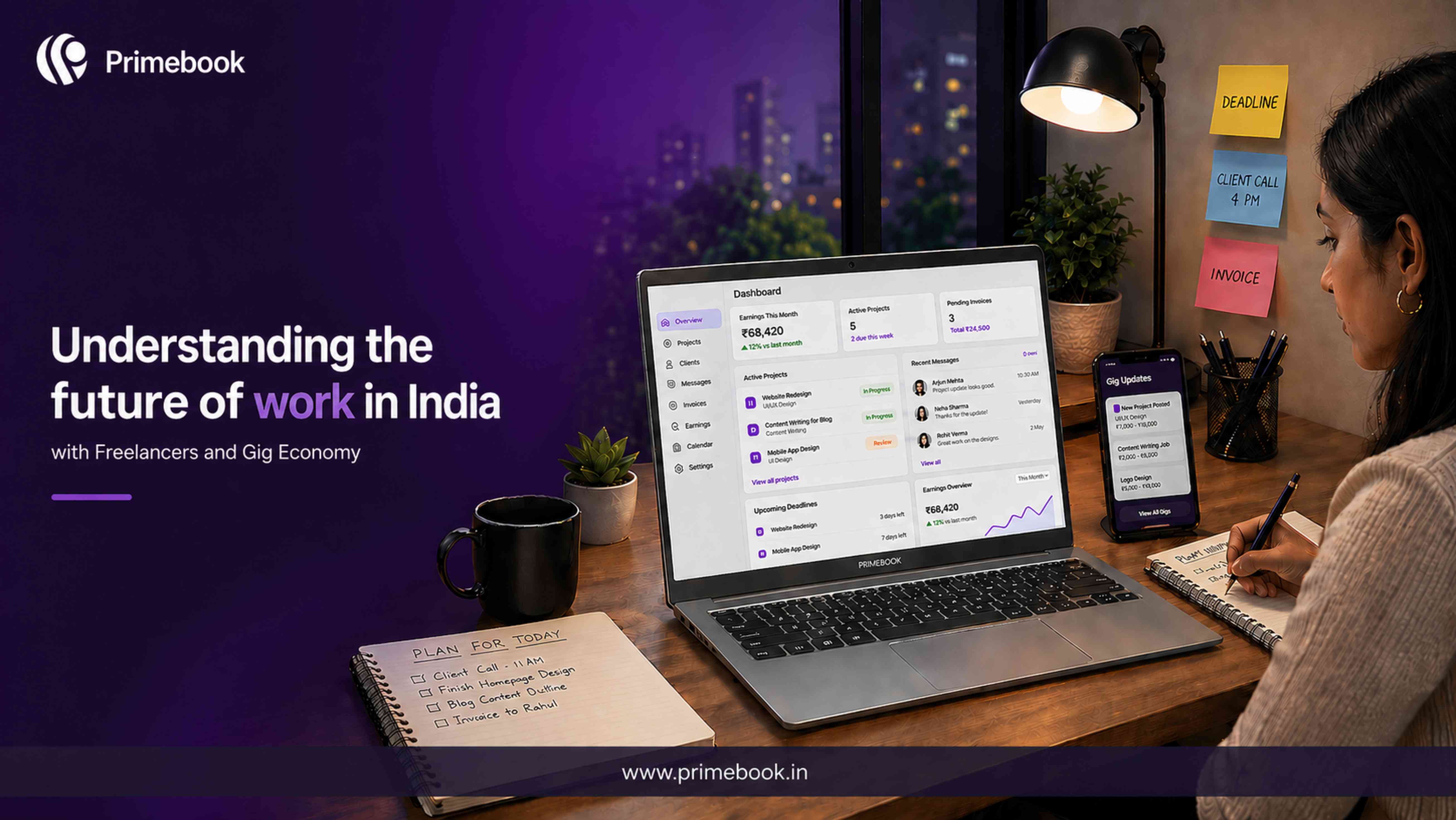
For the Indian worker, this changes three things in practice. One, income now spreads across multiple clients or platforms (a content writer can serve four startups at the same time), so you are no longer locked into one employer. Two, the workstation, internet, software, and tax filing that an office used to handle now sit on your plate. Three, where you used to send a CV, you now build ratings on Upwork, Fiverr, Internshala, Urban Company, Swiggy, or Zomato, and those ratings become your CV. College students writing or designing after class hours and the food delivery rider you ordered from yesterday are part of the same economy, just at different ends of the skill spectrum. A typical day looks like jumping between a client call on Google Meet, a Figma file, a Notion brief, and a WhatsApp thread for revisions, all on the same machine, often from a co-working seat or a home corner that doubles as the office.
Also Read: Why is An Android Laptop Better than Windows for Freelancers in India?
Key areas of employment in Freelancers' or Gig work culture
Right now, India's freelance and gig economy is concentrated in a few clear pockets: technical services (software development, web development), creative work (content writing, graphic design, video), and logistics and delivery (food, travel partners, parcels). But that list keeps growing. Chartered accountants, dieticians, project managers, virtual assistants, and AI-prompt specialists are all stepping into gig work too.
According to Statista's data on freelancing in India, India now ranks among the top three freelancer markets globally, with creative and tech freelancers leading the charge. The newer wave is even more interesting: AI-assisted creators, no-code developers, and short-form video editors, all juggling multi-app workflows where a thumbnail, a script doc, a reference video, and a client chat have to stay open side by side without the system stuttering.
Also Read: Best Laptop for Virtual Assistants in India
Benefits of Freelance or Gig Model of Work
The real benefit of gig work is not "freedom" in some abstract sense. It is the ability to control three specific business levers a salaried role does not give you: pricing, capacity, and client mix. A freelance UX designer can raise her rates with every new portfolio piece, take on three clients in a busy month and one when she needs a break, and walk away from projects that do not fit her positioning. A salaried designer at the same skill level cannot do any of that. Her appraisal is annual and her workload is decided upstream. That is why a NITI Aayog report on the gig economy projects skilled workers as a fast-growing share of the segment, the upside is mathematical, not philosophical.
For the Indian economy, the gig model also fixes a very specific problem: too many young people, not enough formal salaried roles being created each year. A graduate from a Tier-3 city who would otherwise wait six to twelve months for a campus placement can start earning within weeks through platform work, while building a real, verifiable portfolio at the same time. Two or three years in, that usually turns into either a higher-paying full-time role or a fully established independent practice. And with workflow automation moving from tools to full task execution, freelancers can now run client onboarding, invoicing, and follow-ups in the background without losing focus on the actual craft.
Also Read: Find Part-Time WFH Jobs For Indian Students
Is the future of the Indian economy bright in Gig or Freelance culture?
Yes, and the numbers back it. Since the pandemic, with the government doubling down on digital infrastructure to keep the economy moving, freelancers have emerged as a core workforce of the future. The worker share in the gig and freelance economy keeps climbing. As per the NITI Aayog brief, the gig workforce went from 7.7 million in 2020-21 to a projected 23.5 million by 2029-30, a more than three-fold jump in a decade.
Government schemes like the e-Shram portal by the Ministry of Labour & Employment have already registered crores of unorganised and gig workers, which is the State formally acknowledging this segment exists. Pair that with Digital India, Skill India, and the steady rollout of cheap 4G/5G connectivity tracked by TRAI's quarterly performance indicators, and you can see why gig work is no longer a side hustle culture. It is a structural pillar of how India will work in the years ahead.
Frequently Asked Questions
How big will India's gig economy get by 2029-30?
According to the NITI Aayog's Future of Work report, India is projected to host around 23.5 million gig workers by 2029-30, contributing roughly 4.1% to the country's total livelihood. The growth is being driven by digital platforms, creator economies, and demand for flexible work.
Which sectors employ the most freelancers in India?
Technical services (software, web, AI), creative work (content, design, video), and logistics/delivery dominate today. Newer additions include virtual assistants, AI prompt engineers, online tutors, and project-based finance and consulting roles.
What kind of laptop suits a freelancer or gig worker?
Freelancers benefit from a portable, long-battery, multitasking-friendly device that can switch fluidly between communication, design, and writing apps without lag. A lightweight Android laptop with strong battery life and access to mobile-native productivity apps is well aligned with how Indian gig workers actually operate day to day.
Is the gig economy a stable career choice in India?
It is getting there, fast. With formal recognition through e-Shram, social-security debates in the Code on Social Security, and platform-driven income consistency, gig work is moving from a temporary fix to a recognised long-term career path for India's young workforce.