Blogs / Student's Corner / IIM Executive MBA vs Regular MBA
Blogs / Student's Corner / IIM Executive MBA vs Regular MBA

Primebook Team
29 Jul 2026
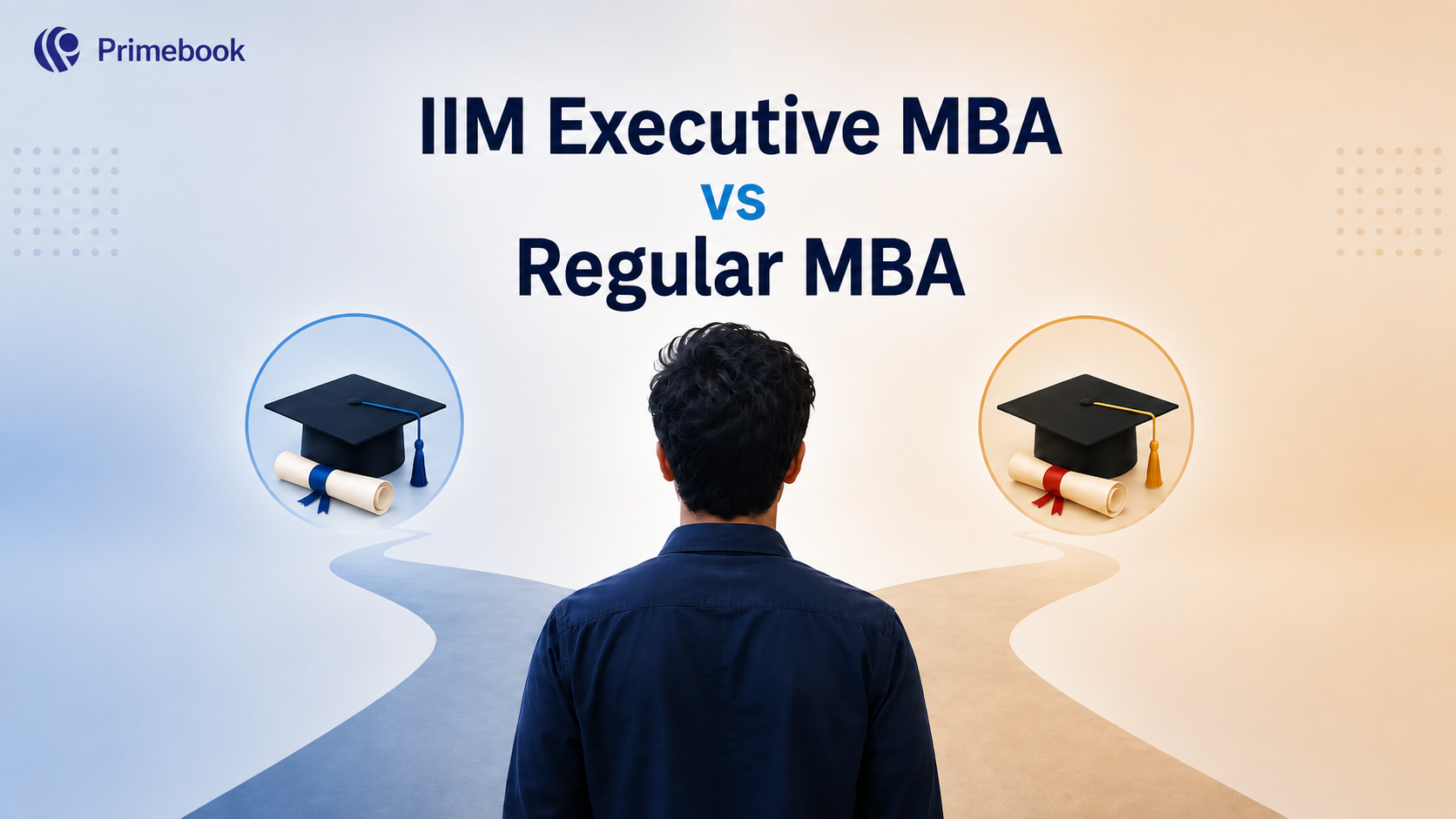
IIM Executive MBA vs Regular MBA
Table of Contents
- Introduction
- Programme Structure and Duration
- Eligibility and Cohort Profile
- Admission Route and Entrance Tests
- Fees and Opportunity Cost
- Placement Outcomes and Salary Signals
- Choosing the Right Route
- Conclusion
- FAQ
Introduction
For working professionals considering an IIM MBA, the biggest question is often whether a one-year Executive MBA or a two-year Regular MBA is the better choice. Indian Institutes of Management (IIMs) offer two distinct full-time MBA routes: a two-year Regular MBA (PGP) and a one-year Executive MBA designed for experienced professionals.
While both programmes carry the IIM brand, they differ significantly in eligibility, programme structure, admission process, costs, and career outcomes. Understanding these differences helps applicants evaluate which programme aligns with their professional background and aspirations.
Programme Structure and Duration
The biggest difference between the two routes is the time spent on campus. According to MBAUniverse, the flagship IIM MBA/PGP is a two-year, full-time residential programme built around a broad general-management foundation, summer internships, and specialisation electives in the second year. It is designed for students who are still building their functional expertise and exploring different functions and industries.
Different IIMs offer their one-year Executive MBA programmes under different names. These include PGPX at IIM Ahmedabad, EPGP at IIM Bangalore, MBAEx at IIM Calcutta, IPMX at IIM Lucknow, and PGP-BL at IIM Kozhikode. All of them are full-time residential programmes. The curriculum is compressed, application-heavy, and designed for someone who already knows how business works but needs frameworks, exposure, and a reset. There is no summer internship, and electives usually kick in far earlier.
In short, the regular MBA is built for exploration, the executive MBA is built for acceleration.
Eligibility and Cohort Profile
Work experience is another major differentiator between the two programmes. As documented by FreeJobAlert, Executive MBA programmes at the IIMs typically require at least 4 to 5 years of full-time work experience, while the average participant often has 7 to 8 years of experience. Regular MBA programmes, in contrast, are open to fresh graduates as well as candidates with limited work experience.
As a result, the classroom composition of the two programmes is very different. IIM Calcutta's MBAEx Class of 2026, per GoalISB, has 90 students with an average work experience of 7.8 years, where 47% carry 5 to 7 years, 36% carry 7 to 10 years, and 18% carry more than a decade. Peer conversations in that room are about scaling teams, P&L ownership, and pivots, not about first-job jitters. In comparison, the IIM Ahmedabad PGP Class of 2026–28 has an average work experience of 24 months, with an average age of 23 years, reflecting a cohort that is much earlier in its professional journey.
Admission Route and Entrance Tests
Although both routes lead to an IIM MBA, they follow different admission pathways. Leading one-year Executive MBA programmes (PGPX, EPGP, MBAEx, IPMX and PGP-BL) typically accept GMAT or GRE scores and do not use CAT. Regular two-year IIM MBA programmes, on the other hand, continue to rely predominantly on CAT for admissions.
For working professionals, this difference affects both preparation and planning. Unlike CAT, which is conducted once a year, the GMAT and GRE can be taken throughout the year and retaken if required, making them easier to fit around a full-time job. That flexibility, however, does not mean the selection process is any less competitive. For example, the IIM Calcutta MBAEx Class of 2026 reported an average GMAT score of 696, highlighting the strong academic profile expected of Executive MBA candidates.
Fees and Opportunity Cost
The tuition fees for Executive MBA and Regular MBA programmes are closer than many applicants expect. Leading one-year Executive MBA programmes at the IIMs typically cost between ₹22 lakh and ₹31 lakh, while two-year Regular MBA programmes generally range from ₹15 lakh to ₹28 lakh. The bigger financial difference comes from programme duration rather than tuition alone. A two-year Regular MBA usually requires candidates to spend an additional year away from full-time employment, whereas Executive MBA participants return to work after one year. For experienced professionals, that extra year can significantly increase the overall cost of pursuing the degree.
Placement Outcomes and Salary Signals
Numbers from recent placement cycles help ground the comparison. At IIM Bangalore, the 2026 final placement report, as covered by Cracku, showed the two-year MBA average CTC at Rs 35.35 lakh per annum, while the executive MBA cohort recorded a higher average of Rs 37.10 lakh and median of Rs 36.50 lakh. These outcomes are best interpreted in the context of participants' existing experience and the seniority of roles they typically pursue after graduation. Consulting alone absorbed roughly 45% of offers in the regular MBA.
IIM Calcutta's MBAEx Class of 2025, per GoalISB, closed with an average CTC of Rs 35 lakh, median Rs 32 lakh, and highest Rs 1.25 crore, with average CTC growing about 65.64% across recent batches. That salary jump captures what the programme is really selling to experienced managers.
Career levels also diverge. FreeJobAlert notes that executive MBAs at IIMs consistently place into mid-to-senior roles, director, VP, senior consulting, and strategy tracks, while regular MBAs primarily open entry-level or early-management roles even when salaries look comparable.
Global signals reinforce the picture. In QS Executive MBA Rankings 2026, as reported by the Indian Express, IIM Bangalore ranked 64th globally, the only Indian institute in the top 100, though it slipped 14 places year-on-year on career-outcome scores. While placement reports reflect outcomes within an institute, global rankings provide another perspective by evaluating executive MBA programmes across multiple international parameters.
Choosing the Right Route
There is no universally better option. The right choice depends on where you are in your career and what you want the MBA to help you achieve. A Regular MBA is designed to help candidates build the foundation of their management careers, offering internships, functional exposure, and time to explore different career paths. An Executive MBA, by contrast, caters to experienced professionals looking to accelerate or redirect an established career.
If you have less than two years of work experience and are open to exploring different functions, the two-year MBA generally offers greater flexibility through internships and a longer learning period. If you have five or more years of work experience, a defined domain, and a specific career pivot in mind, the one-year Executive MBA can help you transition without stepping back into an early-career cohort.
Enrolling in a programme designed for a different level of professional experience can reduce the value of the learning and recruitment opportunities. For instance, fresh graduates are unlikely to benefit from an Executive MBA designed around the experiences of seasoned professionals, while experienced managers may find that a two-year Regular MBA offers fewer advantages than a one-year Executive MBA tailored to their level of experience.
Also Read:
- Pursue MBA from Delhi University: Eligibility, Fees, etc.!
- Check the Detailed Syllabus of MBA Courses at Delhi University
- Planning for GMAT 2025 Exam? Eligibility, Pattern, Application, and Cut-Off
Conclusion
Much of an MBA's value lies beyond the curriculum. The classroom discussions, peer network, and shared professional experiences often shape the learning as much as the coursework itself. That is why the cohort profile matters as much as the curriculum itself. You often learn as much from classmates solving similar business challenges as you do from the classroom.
FAQ
Is an IIM executive MBA considered equivalent to a regular MBA?
An Executive MBA is not the senior version of a Regular MBA, nor is a Regular MBA a prerequisite for an Executive MBA. They are parallel programmes designed for different entry points in a professional journey. Recognising that distinction helps applicants move beyond comparing prestige, rankings, or chronology, and instead choose the programme that best aligns with their career stage and long-term goals.
Can I pursue an Executive MBA at an IIM without leaving my job?
It depends on the programme. Most flagship one-year Executive MBA programmes at the IIMs are full-time and residential, requiring candidates to take a career break. However, some IIMs also offer part-time, modular, or online executive management programmes designed for working professionals. Applicants should check the specific programme format before applying.
Can fresh graduates apply for an IIM Executive MBA?
Generally, no. Most one-year Executive MBA programmes at the IIMs require at least four to five years of full-time work experience. Fresh graduates and early-career professionals are typically eligible only for the two-year Regular MBA programmes.
Is one year enough to switch careers meaningfully?
For someone with 5 or more years of work experience, one year is usually enough to pivot function or industry, because the classroom is compressed and recruiters treat the cohort as senior-ready. For a fresh graduate with no functional base to leverage, a two-year MBA with an internship is generally the more realistic switch route.
Editorial Transparency: Primebook's editorial team uses a combination of human expertise, research, and AI-powered tools to create and refine content. Every article is reviewed and validated by our team before publication to ensure accuracy, clarity, and usefulness for readers.

 Related Blog