Blogs / Student's Corner / SSC CGL 2026: Date, Exam Pattern, and Syllabus!
Blogs / Student's Corner / SSC CGL 2026: Date, Exam Pattern, and Syllabus!

Primebook Team
15 Jan 2026
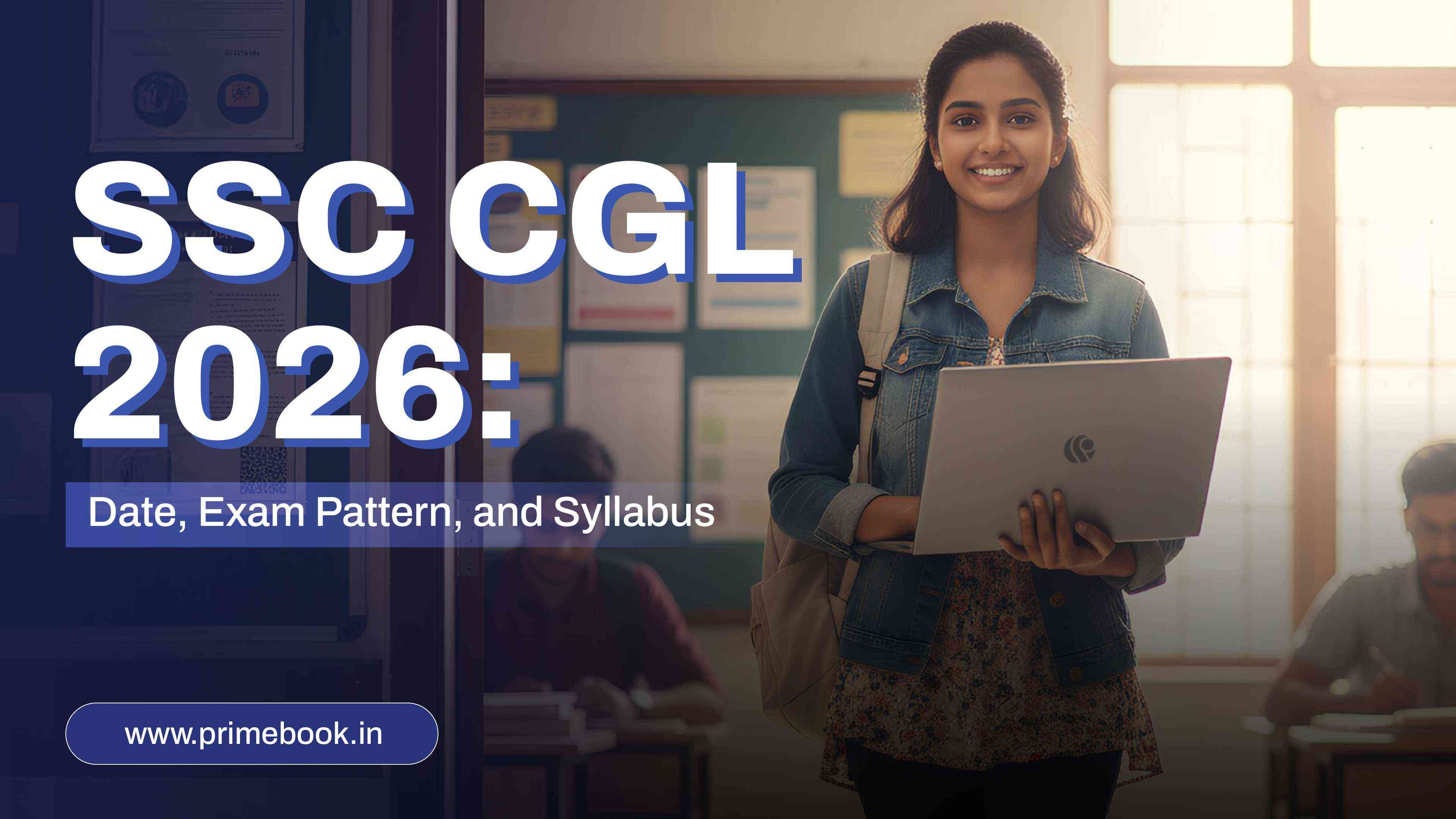
SSC CGL 2026: Date, Exam Pattern, and Syllabus!
While the official notification for SSC CGL 2026 is yet to be released, getting clarity on the expected dates, exam pattern, and syllabus gives aspirants an early-mover advantage. It helps candidates structure their preparation, prioritise subjects, and avoid uncertainty once the application process begins. This blog brings together all the key details related to SSC CGL 2026, including the exam timeline, test pattern, and detailed syllabus, strictly based on officially followed SSC formats and previous examination cycles.
Overview of SSC CGL 2026
The SSC Combined Graduate Level (CGL) examination is a national-level competitive exam conducted for recruitment to various graduate-level posts under the Government of India. Conducted by the Staff Selection Commission, the exam is used to fill Group B and Group C positions across ministries, departments, and offices based on merit and post preferences.
In the previous SSC CGL cycle, the examination was conducted at 255 exam centres across 126 cities in India, as confirmed by official government releases. SSC CGL 2026 is expected to follow a similar nationwide centre distribution, unless stated otherwise in the official notification.
To be eligible for SSC CGL 2026:
-
You must be a citizen of India.
-
You must hold a bachelor’s degree from a recognised university.
-
You must meet the age criteria prescribed for the specific post applied for.
There is no limit on the number of attempts, subject to age eligibility. Detailed registration instructions will be released along with the official notification.
SSC CGL 2026 Important Dates (Tentative)
Based on the schedule followed in recent SSC CGL examination cycles, here is the expected timeline for SSC CGL 2026.
|
SSC CGL 2026 Notification Release Date |
April-May 2026 |
|
SSC CGL 2026 Registration Start Date |
April 2026 |
|
SSC CGL 2026 Registration End Date |
May 2026 |
|
Application Correction Window |
May-June 2026 |
|
SSC CGL 2026 Tier-I Exam Admit Card Release Date |
June 2026 |
|
SSC CGL 2026 Tier-I Examination Date |
June-July 2026 |
|
SSC CGL 2026 Tier-I Result Date |
July-August 2026 |
|
SSC CGL 2026 Tier-II Admit Card Release Date |
September 2026 |
|
SSC CGL 2026 Tier-II Examination Date |
September-October 2026 |
|
SSC CGL 2026 Final Result Date |
October-November 2026 |
Also Read: RAS 2026: Exam Date, Registration Process, and Eligibility Criteria
SSC CGL 2026 Exam Pattern
The SSC CGL examination follows a defined structure that remains consistent across cycles, unless any changes are mentioned in the official notification. Here’s the detailed outline below.
|
Particulars |
Details |
|
Exam Level |
National |
|
Exam Frequency |
Once a year |
|
Mode of Examination |
Computer-Based Test (CBT) |
|
Stages of Examination |
Tier-I (qualifying round), followed by Tier-II (final merit determination) |
No. of Papers in Each Tier |
Tier-I: 1 (Compulsory); Tier-II: 1 compulsory (Paper I) + 1 selective (Paper II or Paper III, post-specific) |
Medium of Examination |
English and Hindi (except for the language and comprehension sections in both Tier I and Tier II rounds, which are English only) |
|
Type of Questions |
Multiple Choice Questions (MCQs) |
|
Total No. of Questions for Tier-I |
100 |
|
Total No. of Questions for Tier-II |
Paper-wise, as notified by SSC |
|
Duration of Exam for Tier-I |
60 minutes |
|
Duration of Exam for Tier-II |
Paper-wise, as notified by SSC |
|
Negative Marking |
Applicable in both tiers; varies by paper (Tier-I: 0.50 marks per wrong answer; Tier-II: 0.50 marks for Paper I Sections I-III, and 1 mark for Paper II & Paper III; but DEST has no negative marking.) |
Also Read: SSC CGL Registration Process
SSC CGL Syllabus 2026
The SSC CGL syllabus is based on subjects commonly covered at the graduate level: aptitude, language, awareness, and more, as defined by the Staff Selection Commission through its examination framework. The syllabus is structured separately for Tier-I and Tier-II, with Tier-II including additional post-specific papers as notified by SSC.
Tier-I Syllabus
General Intelligence & Reasoning
-
Analogies
-
Similarities and differences
-
Coding-decoding
-
Series (number, alphabet, figure-based)
-
Syllogism
-
Venn diagrams
-
Direction sense
-
Blood relations
-
Logical reasoning
General Awareness
-
Current events
-
Indian history
-
Indian polity and constitution
-
Geography (India and world)
-
Economics
-
General science
-
Static GK
Quantitative Aptitude
-
Number system
-
Percentage
-
Ratio and proportion
-
Profit and loss
-
Simple and compound interest
-
Time and work
-
Time, speed, and distance
-
Algebra
-
Geometry
-
Mensuration
-
Trigonometry
-
Data interpretation
English Comprehension
-
Reading comprehension
-
Vocabulary
-
Grammar and usage
-
Error spotting
-
Sentence correctio
-
Cloze test
Also Read: CTET 2026 Exam Date and Preparation Strategy
Tier-II Syllabus
Paper I (Compulsory for All Candidates)
Section I: Mathematical Abilities
-
Number system
-
Algebra
-
Geometry
-
Mensuration
-
Trigonometry
-
Statistics
-
Probability
Section II: Reasoning & General Intelligence
-
Logical reasoning
-
Analytical reasoning
-
Non-verbal reasoning
Section III: English Language & Comprehension
-
Grammar
-
Vocabulary
-
Reading comprehension
-
Sentence structure
Section IV: Computer Knowledge
-
Computer fundamentals
-
Hardware and software basics
-
Operating systems
-
Networking basics
-
Internet and email
-
MS Office basics
Data Entry Speed Test (DEST)
-
Qualifying in nature
-
Speed requirement: 2000 key depressions in 15 minutes
Paper II: Statistics (For Statistical Investigator Posts)
-
Collection, classification, and presentation of data
-
Measures of central tendency
-
Measures of dispersion
-
Probability theory
-
Random variables
-
Correlation and regression
-
Sampling theory
Paper III: General Studies (Finance & Economics)
(For Assistant Audit Officer / Assistant Accounts Officer Posts)
Finance
-
Financial accounting
-
Financial statements
-
Auditing principles
-
Accounting standards
Economics
-
Microeconomics
-
Macroeconomics
-
Indian economy
-
Economic reforms
-
Fiscal and monetary policy
Also Read: UPSC 2026: Exam Date, Registration Process, and Preparation Strategy
To sum up, one aspect often overlooked in SSC CGL preparation is how the exam evolves at the implementation level rather than at the syllabus level. While subjects and structure remain familiar, factors such as exam scale, multi-shift normalisation, and post-specific Tier-II papers play a decisive role in outcomes. Being aware of this helps aspirants approach the exam with realistic expectations, focusing not just on what to study but also on adaptability during the process. As SSC CGL continues to be conducted at a massive scale across the nation, consistency and exam-day execution become as important as subject knowledge.
For more details on National and State Level Competitive Exams in India, stay tuned to Primebook’s Students’ Corner.


 Related Blog