Blogs / Student's Corner / Top Short-Term Courses to Pursue After BCom in 2026
Blogs / Student's Corner / Top Short-Term Courses to Pursue After BCom in 2026

Primebook Team
08 May 2026
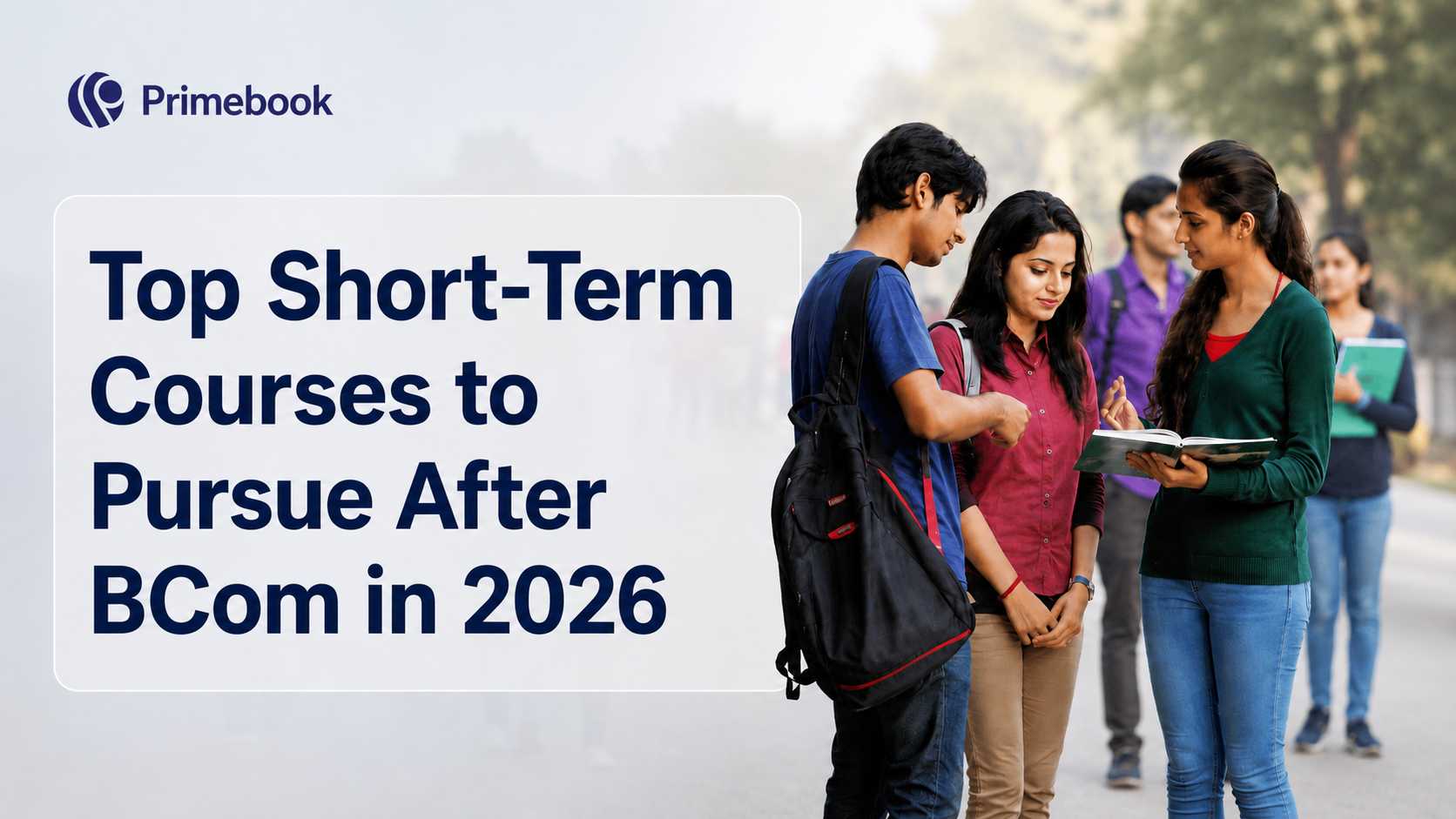
Top Short-Term Courses to Pursue After BCom in 2026
Table of Contents
- Introduction
- Top 5 Short-Term Courses to Pursue After B.Com. in 2026
- Conclusion
- Frequently Asked Questions
Introduction
A B.Com. degree builds the foundation, but the Indian job market in 2026 rewards specialisation, not generalisation. Recruiters across finance, fintech, and digital roles are filtering candidates by certifications tied to specific functional skills. Most B.Com. graduates step out with strong theory but soft positioning, and the first job offer reflects that gap.
Common belief says you need another full degree to upskill. The reality is different. A focused short-term course (3 to 12 months) can sharpen a B.Com. degree into a hireable profile faster than a second degree, and at a fraction of the time investment. The shift is not about studying more; it is about gaining skills that map clearly to real hiring demand.
This list breaks down five short-term courses worth considering after B.Com. in 2026, with realistic duration, fee ranges, career direction, and honest limitations for each. The aim is to help you choose based on your actual career direction, not a generic ranking.
Also Read: Best Career Options After BCom in 2026
Top 5 Short-Term Courses to Pursue After B.Com. in 2026
1. Certified Management Accountant (CMA) - US
The CMA US certification by IMA has gained traction among Indian B.Com. graduates targeting roles in MNC finance functions, GCCs, and management accounting teams. Unlike traditional audit-led tracks, CMA focuses on financial planning, analysis, and business decision support. According to the NASSCOM–Zinnov GCC report, India continues to strengthen its position as a global hub for GCCs, with these centres increasingly expanding into high-value business and finance functions. This makes CMA particularly relevant for graduates aspiring to build careers in FP&A, controllership, and strategic finance.
What makes it work:
- Duration: 12 to 18 months across two parts
- Approximate fee: Rs 1,00,000 to Rs 1,80,000 including IMA membership
- Career direction: FP&A, management accounting, business finance roles in GCCs
- 2026 demand signal: Growing GCC hiring across Bengaluru, Hyderabad, Pune
- Format: Two-part exam, online proctored available
Limitations:
- Less recognition outside the MNC and GCC ecosystems
- Self-study is heavy, requires strong discipline
- Fees in foreign currency, exchange rate exposure
2. Financial Modelling and Valuation Certification
Financial modelling is the practical skill most B.Com. curriculums skip. Investment banking divisions, equity research desks, and corporate finance teams hire on this skill specifically. A focused certification covering Excel modelling, DCF valuation, comparable company analysis, and LBO frameworks bridges the gap between theory and execution. Several Indian institutes and online platforms offer recognised programmes; verify the curriculum matches industry templates before enrolling.
What makes it work:
- Duration: 2 to 4 months
- Approximate fee: Rs 25,000 to Rs 60,000
- Career direction: Investment banking analyst, equity research, corporate finance
- Tools covered: Excel, DCF, comparables, LBO frameworks
- Format: Live cases, model templates, recorded sessions
Limitations:
- Quality varies sharply across providers; due diligence is essential
- Certification alone rarely lands top-tier IB roles; internships still matter
- Skill needs continuous practice post-certification
3. Digital Marketing Certification
Commerce graduates with an interest in business strategy and consumer behaviour often pivot well into digital marketing. The Skill India Digital portal hosts several recognised programmes, and platforms like Google offer industry-aligned certifications. Roles span SEO, performance marketing, content strategy, and analytics. For deeper context on the segment, see Free Digital Marketing Course by Government of India.
What makes it work:
- Duration: 3 to 6 months
- Approximate fee: Free to Rs 50,000, depending on the provider
- Career direction: Performance marketing, SEO, content strategy, analytics
- Format: Online, project-based
- Entry barrier: Low, broad employer base from startups to agencies
Limitations:
- Entry-level salaries are lower than those for finance certifications
- Highly saturated entry-level talent pool
- Algorithm and platform shifts force frequent re-learning
4. Data Analytics for Business
Data analytics has become a core operating skill across finance, marketing, and operations. B.Com. graduates with analytics certification stand out in roles like business analyst, financial analyst, and operations analyst. Programmes typically cover Excel advanced functions, SQL, Power BI or Tableau, and basic Python. Learners can also explore data analytics courses available through the Government of India's Skill India Digital platform and other recognised skilling initiatives.
What makes it work:
- Duration: 4 to 8 months
- Approximate fee: Rs 30,000 to Rs 90,000
- Career direction: Business analyst, financial analyst, operations analyst
- Tools covered: Excel, SQL, Power BI, Tableau, basics of Python
- Cross-industry fit: Banking, e-commerce, consulting, SaaS
Limitations:
- Requires comfort with logical and quantitative thinking
- The tool stack evolves quickly, and regular upskilling is necessary
- A pure B.Com. background may need extra effort on technical depth
Also Read: Platforms to Learn Data Science
5. Banking and Financial Services Certification (NISM and IIBF)
For B.Com. graduates aiming at banking, broking, mutual fund, and wealth advisory roles, certifications from NISM and IIBF are statutory or strongly preferred. NISM modules cover mutual funds, equity derivatives, research analyst, and investment advisory; IIBF covers JAIIB and CAIIB for banking professionals. These are short, exam-based, and inexpensive, making them efficient additions to a B.Com. profile.
What makes it work:
- Duration: 1 to 4 months per module
- Approximate fee: Rs 1,500 to Rs 6,000 per certification
- Career direction: Wealth advisory, mutual fund distribution, banking, research
- Recognition: Regulatory bodies (SEBI-mandated for several roles)
- Stackable: Multiple modules can be combined
Limitations:
- Narrow scope per module, individually less impactful
- Self-study format, no structured mentorship
- Salary uplift modest unless paired with a stronger qualification
Also Read: Top 10 Courses to Avail After BA
Conclusion
Picking the right short-term course after B.Com. is less about prestige and more about sequencing. CMA suits candidates ready to invest a longer stretch in a single deep track. Financial modelling and analytics suit those who want a faster bridge into analytical roles. NISM and IIBF suit candidates who need regulatory eligibility quickly and prefer to stack modules over time.
The honest filter for 2026 is simple: choose the course you will actually use within three months of finishing it. A certification that sits on a CV without follow-through fades in value; one that directly improves the work you do daily stays valuable as your experience grows.
Frequently Asked Questions
Which short-term course after B.Com. gives the fastest job entry in 2026?
NISM and IIBF certifications offer the fastest route, often clearing in 1 to 4 months and helping qualify for SEBI-mandated roles in mutual fund distribution, broking, and banking. They are inexpensive, exam-based, and stackable, which makes them the quickest pivot for B.Com. graduates targeting financial services.
Is CMA US worth it for an Indian B.Com. graduate?
CMA US holds strong value if your target is FP&A or management accounting roles inside MNCs and Global Capability Centres in India. It is less relevant for purely domestic audit or compliance work. Match the certification to the hiring ecosystem you want to enter.
Can a B.Com. graduate move into data analytics with a short-term course?
Yes, a 4 to 8-month analytics certification covering Excel, SQL, Power BI or Tableau, and basic Python can position a B.Com. graduate for business analyst and financial analyst roles. Continuous practice on real datasets matters more than the certificate itself.
How much do these short-term courses after B.Com. cost in India?
The range is wide. NISM and IIBF modules start around Rs 1,500 per certification, while CMA US can reach Rs 1,80,000 end-to-end. Financial modelling, digital marketing, and analytics programmes typically sit between Rs 25,000 and Rs 90,000.


 Related Blog