Blogs / Trendy Tech Talks / What Is An Iot Platform
Blogs / Trendy Tech Talks / What Is An Iot Platform

Primebook Team
14 Aug 2024
What Is An Iot Platform
Table of Contents
- Introduction
- What Is An IoT Platform?
- Capabilities of An IoT Platform
- Why Avail of An IoT Platform?
- Conclusion
- FAQ
Introduction
The Internet of Things has moved well past the buzzword phase. In India alone, the IoT market was valued at USD 1.50 billion in 2025 and is projected to reach USD 3.62 billion by 2034, expanding at a CAGR of 10.32% between 2026 and 2034. That growth is not being driven by devices sitting on shelves; it is being driven by the invisible software layer that ties those devices together, the IoT platform.
While IoT is a complex ecosystem spanning a network of limitless devices and applications from the physical and digital world, an IoT platform backs the entire connectivity and communication among the different components via one application. It not only helps connect thousands of devices and sensors but also connects a new device to the existing connected bulk. This blog covers all you need to know about an IoT platform to create, manage, and enhance the IoT solutions within your business.
What Is An IoT Platform?
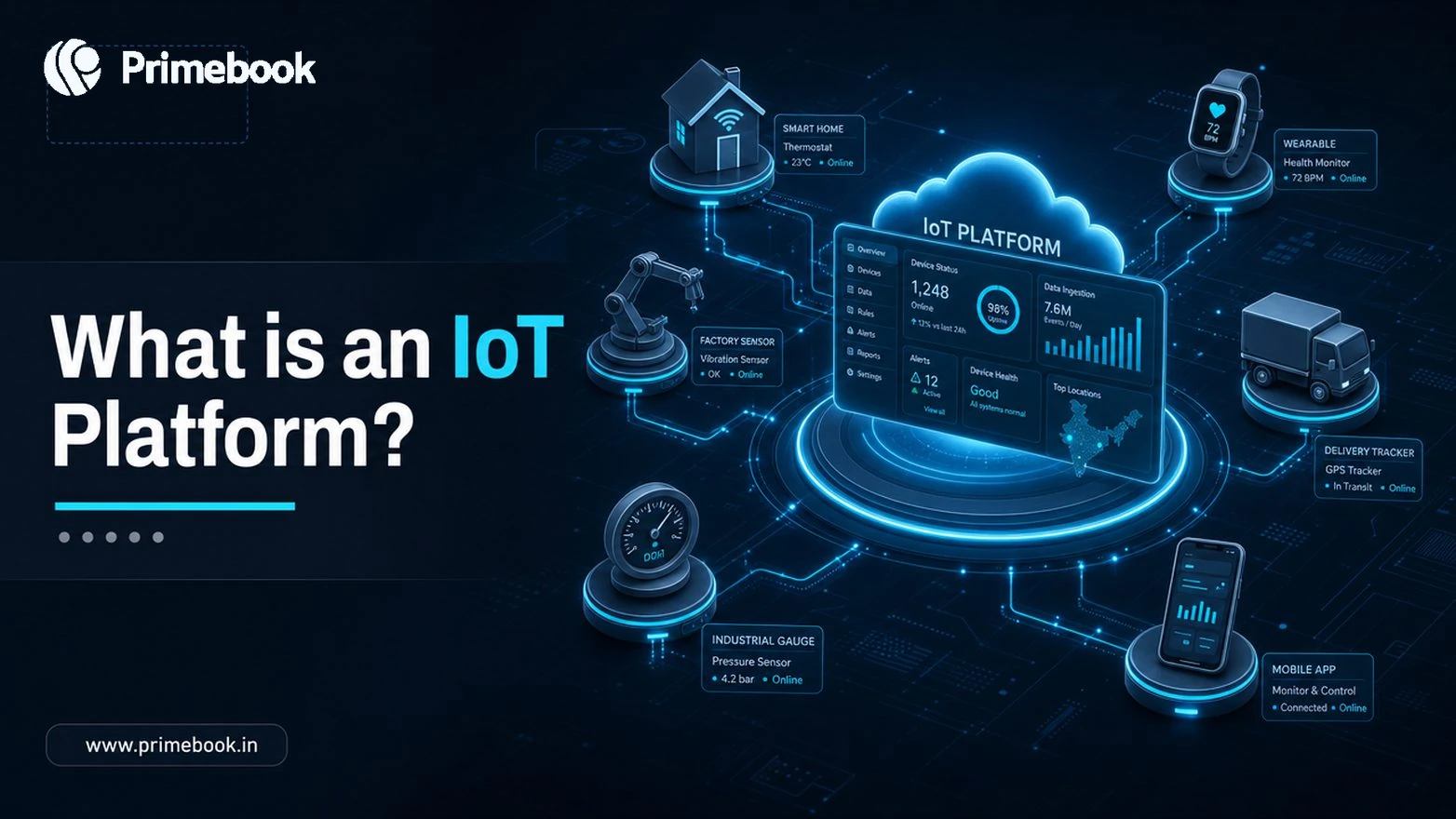
An IoT platform is typically the service or application embedding various in-built tools and functionalities to connect all "things" in an IoT ecosystem. In other words, an IoT platform is what offers the entire infrastructure to simplify and harmonise the diverse parts of an IoT system. This platform serves as the main foundation for building and maintaining IoT solutions within your business enterprise.
In a typical IoT deployment, devices collect data, gateways or networks transmit it to the IoT platform, and the platform processes, stores, analyses, and forwards that information to dashboards or business applications. This central layer is what enables organisations to monitor devices, automate workflows, and manage connected systems at scale.
IoT platforms are commonly grouped into four functional categories, namely Cloud Platform (also called Application Enablement Platform), IoT Device Platform, IoT Connectivity Platform, and Analytics Platform. Cloud platforms remain the most commonly used, further categorised into industrial platforms, consumer platforms, high-level drag-and-drop platforms suitable for prototyping, and platforms targeting developers. Market forecasts project continued growth in the global IoT market through 2030, reinforcing the importance of scalable IoT infrastructure across industries.
Capabilities of An IoT Platform
Irrespective of where your business stands on the IoT journey, an IoT platform holds multiple significant capabilities, and here they go.
Seamless IoT Connectivity
At the heart of IoT, numerous devices are connected using protocols, facilitating information sharing and the generation of new insights. An IoT platform provides seamless and reliable connectivity across diverse device types and communication protocols. It is also essential for devices without native IoT protocols, as it can provide a software development kit for integrating the device with the rest of the IoT ecosystem. In India, services accounted for 65% of the IoT connectivity market in 2025, reflecting the growing importance of managed connectivity and integration services.
IoT Device Lifecycle Management
An IoT platform takes an enterprise through the entire device lifecycle management process, from planning and onboarding to retirement, from a centralised location. While updating and communicating with devices in a secure, controlled, and phased manner stands crucial for an enterprise IoT deployment, an IoT platform enables accessing and monitoring critical information like GPS location, alarms and errors for this definite purpose.
IoT Data Management
Since IoT data is a valuable source of insight for businesses, their customers, customer's end-users, and partners, an IoT platform can facilitate scalable IoT data management. From data logging and storing to data processing and management of data transactions, an IoT platform can take care of it all. Furthermore, such a platform can manage device actions based on various types of real-time data coming from many devices and locations.
Reliable IoT Integration
An IoT platform isn't a mere storage for data extracted via IoT sensors. Instead, it's a salient hub to integrate IoT data with other business systems and processes through robust and intuitive routes. By using an IoT platform, businesses can integrate device data with cloud apps, enterprise apps, big data apps, third-party apps, app ecosystems, and automated actions and workflows across OT and IT assets, that too, without heavy coding.
Efficient IoT Data Analysis
The value of an IoT system depends on how accurate and relevant the data derived from its sensors and devices is. Such data value culminates from precise and efficient data analytics that include historical analysis, real-time analysis, and predictive analysis. By applying context to IoT data, the platform helps uncover actionable insights that support real-time decision-making.
IoT Application Development
To build and maintain an IoT application, technical expertise, resources, and time are requisite. Here, an IoT platform's application enablement feature removes the technical hurdles in creating and deploying IoT applications. By using such a platform, businesses can develop custom applications and also extend the platform's default application to meet a specific business need.
Why Avail of An IoT Platform?
1. IoT platforms empower businesses to start new IoT projects and scale them to the fullest, to bring forth efficient customer-centric services and set a competitive edge in the continuously evolving market landscape.
2. An IoT platform lets businesses eliminate technical complexities from IoT projects and subsequently pay heed to real business outcomes.
3. By availing of an IoT platform, enterprises can create an out-of-the-box set of capabilities for IoT solutions, which can further be used to build differentiating logic and software applications for the business.
The sector-level demand also shows why this matters right now in India. Smart Energy and Utility accounted for the largest application segment, with a 22% share of the India IoT connectivity market in 2025, driven by smart metering and grid monitoring. Separately, Manufacturing was the largest end-use industry, accounting for an 18% share, supported by Industry 4.0 initiatives and connected factory adoption. These are exactly the deployments where an IoT platform, not just a device, is doing the real work.
Conclusion
One of the reasons IoT platforms receive less attention than smart devices is that users rarely interact with them directly. Yet, as connected ecosystems grow larger, the platform increasingly becomes the technology that determines whether an IoT deployment remains reliable, secure, and scalable over time. In many ways, the most important part of an IoT system is also the least visible.
Also Read:
- What is IoT Industry 4.0 and How it Matters?
- The Rise of Smart Classroom: IoT-Enabled Learning Spaces!
- Advantages and Disadvantages of the Internet of Things (IoT)
FAQ
What is the main purpose of an IoT platform?
An IoT platform provides the software infrastructure that connects devices, manages their lifecycle, ingests their data, and integrates that data with business applications. It is what turns a scattered set of sensors and devices into a coordinated system that can be monitored, automated and scaled.
How is an IoT platform different from an IoT device?
A device is a physical sensor, gateway or actuator that captures or acts on data. An IoT platform is the software layer that manages many such devices at once, handles their connectivity, stores and analyses their data, and exposes it to applications. Devices alone can measure; a platform makes them useful at scale.
Why is the IoT platform market growing so fast in India?
Enterprise adoption in energy, utilities and manufacturing is pushing demand for managed connectivity, analytics and device management, all of which sit on the platform layer. India-focused forecasts project the IoT platform market to grow from USD 10.5 billion in 2024 to USD 45 billion by 2035 at a 14.14% CAGR, driven largely by these enterprise use cases.
Do small businesses need an IoT platform?
If a business runs only a handful of connected devices, a full IoT platform may be overkill. But once devices scale into the dozens or hundreds, or once data has to flow into billing, inventory or CRM systems, a platform stops being optional and starts being the only sane way to keep the deployment maintainable.
Which industries use IoT platforms?
IoT platforms are used wherever large numbers of connected devices need to be managed. Common applications include manufacturing, healthcare, agriculture, logistics, retail, energy and utilities, and smart city infrastructure.
Editorial Transparency: Primebook's editorial team uses a combination of human expertise, research, and AI-powered tools to create and refine content. Every article is reviewed and validated by our team before publication to ensure accuracy, clarity, and usefulness for readers.
 Related Blog