Blogs / Trendy Tech Talks / What is Operator AI? How AI is Moving from Assistance to Execution?
Blogs / Trendy Tech Talks / What is Operator AI? How AI is Moving from Assistance to Execution?

Primebook Team
31 Mar 2026
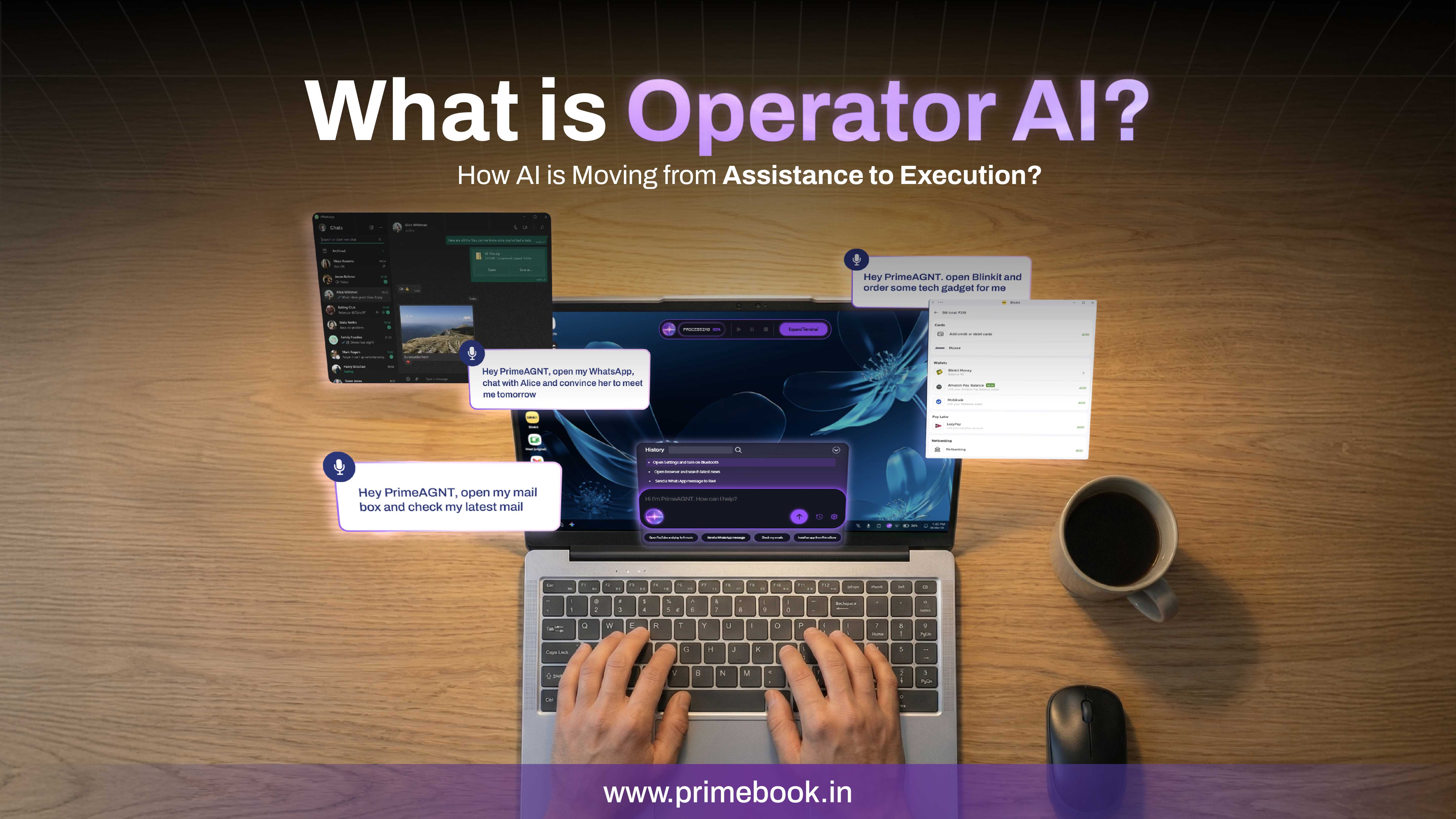
What is Operator AI? How AI is Moving from Assistance to Execution?
Digital work today is no longer limited by access to information. It is defined by how efficiently tasks can be completed across multiple tools and environments.
Yet, most workflows remain fragmented. Even simple tasks require users to move between apps, manage steps, and coordinate actions manually. Research shows that knowledge workers spend 60% of their time on “work about work”, like emails, follow-ups, searching for information, and managing processes, rather than actual execution.
AI has improved parts of this process. It can generate content, answer queries, and support decisions. But it still leaves the responsibility of execution to the user. Tasks may become easier, but they are not fully completed.
The problem is no longer getting answers. It is getting things done. While recent agent-based systems have started automating parts of workflows, they still require users to guide execution, switch contexts, and complete the process across tools.
This is where a new approach begins to take shape, one that moves beyond assistance toward execution, called Operator AI. In this blog, we explore what Operator AI is, how it differs from existing AI systems, and why it represents the next step in how computing systems are built and experienced.
What is Operator AI?
Operator AI is an AI capability built directly into the operating system that can execute tasks on behalf of the user.
It works by understanding user intent through natural language (voice or text) and translating it into a sequence of actions. Instead of users interacting with individual apps, it coordinates actions across applications, system settings, and browser environments to complete a task end-to-end.
Because it is integrated into the operating system, it is not limited to a single app or workflow. It can operate across the system environment, allowing tasks to move between tools without manual coordination.
It can also execute tasks in the background while the user continues working on some other tasks, and understand the on-screen context to take actions based on what is visible.
In simple terms, Operator AI converts intent into completed outcomes by handling execution.
Also Read: What is Agentic AI
Industry Context: How is Execution-Driven AI Emerging
The shift toward execution-driven AI is beginning to take shape across the industry.
In 2025, OpenAI introduced Operator, an AI system capable of performing tasks by interacting with a web browser, navigating websites, filling forms, and completing actions within web-based environments.
Alongside this, concepts such as EllaClaw, developed by Techno in collaboration with OpenClaw, explore execution through terminal-based environments, where tasks are carried out using command-level interactions.
Each of these approaches expands how AI can interact with digital systems. However, execution in both cases is defined by the layer they operate in, either browser interfaces or command-line environments.
As execution becomes more central to computing, the next layer begins to emerge, one that is not tied to a specific interface but extends across the system itself.
This layer is defined as Operator AI, a category where systems are designed to handle tasks end-to-end across applications and environments.
Primebook brings this category to life through PrimeAGNT, an Operator AI capability built directly into PrimeOS, extending execution beyond individual environments into the system layer.
Also Read: Emotion-Sensitive AI
PrimeAGNT: Operator AI at the System Level
PrimeAGNT is built directly into Primebook’s proprietary operating system, making execution a native capability of PrimeOS rather than an external layer. It is designed specifically for Primebook laptops, where the hardware and operating system work together to enable this level of control.
It processes user intent and converts it into structured actions that can be carried out without requiring intermediate input. Because of this integration, it enables a hands-free computing experience, where tasks can be completed without continuous manual interaction with the device.
Execution is coordinated internally, allowing workflows to move across different parts of the system as a single flow. It can operate independently of the user’s active session, enabling tasks to continue in the background while other work is in progress.
In effect, PrimeAGNT shifts execution from something the user manages to something the system handles as part of its core behaviour.
Also Read: Artificial Intelligence in Education
Real-World Use Cases: How Operator AI (PrimeAGNT) Works in Practice
The impact of Operator AI becomes clearer when seen in everyday tasks. Instead of managing steps across tools, users can define what needs to be done, and the system completes the workflow.
For instance, a user can say:
-
“Go through my class WhatsApp group, find what I need to study, and set up a plan for me.”
PrimeAGNT scans conversations, filters relevant information, extracts key tasks, and organises them into a structured study plan.
In a work context, a user can say:
-
“Create my weekly work report based on everything I’ve done this week and prepare it to send.”
PrimeAGNT gathers updates across tasks and activities, compiles them into a structured report, and prepares it for sharing.
For system-level organisation, a user can say:
-
“Organise all my important documents and label them properly.”
PrimeAGNT scans files, categorises them, renames documents, and structures folders accordingly.
In a creator workflow, a user can say:
-
“Go through my Instagram comments, find what my audience is asking for, and create a content plan for next week.”
PrimeAGNT identifies recurring themes, converts them into content ideas, and organises them into a clear plan.
In a professional use case, a user can say:
-
“Find relevant jobs for me on LinkedIn, customise my resume for each role, and apply to them.”
PrimeAGNT identifies suitable opportunities, tailors applications, and completes the process across the workflow.
Across these scenarios, the role of the user shifts from executing each step to defining the outcome, while the system handles the process.
Also Read: How to Use Live AI Assistant on Primebook 2
Key Benefits of Operator AI
As this capability becomes part of everyday computing, its advantages become more evident.
-
Time Saving: Operator AI eliminates repetitive, multi-step workflows by handling execution end-to-end.
-
Reduced Effort: It removes the need to switch between apps or manage tasks manually.
-
Higher Productivity: Tasks get completed faster with fewer inputs.
-
Accessibility: Complex workflows can be executed through simple instructions using the Operator AI.
-
Consistency: The AI reduces errors in repetitive processes by standardising execution.
-
Decision Simplification: It handles intermediate decisions, reducing the need for constant input.
-
Better Use of Time: Operator AI is ultimately meant to free up time for higher-value work like creativity, problem-solving, and skill development
Also Read: Cybercrime Awareness
In a nutshell, the next phase of computing will not be defined by how many tools a system offers, but by how much of the work it can take ownership of. As execution becomes embedded into the system itself, the role of the user begins to shift, from operating software to directing outcomes.
Operator AI reflects this transition. It introduces a model where computing is no longer a series of interactions, but a process of delegation.
As systems take on greater responsibility, the way they are designed becomes equally important. With PrimeAGNT, this shift is supported by a focus on responsible AI practices. Primebook is giving ample attention to user control, data security, and privacy built into how the system operates.


 Related Blog