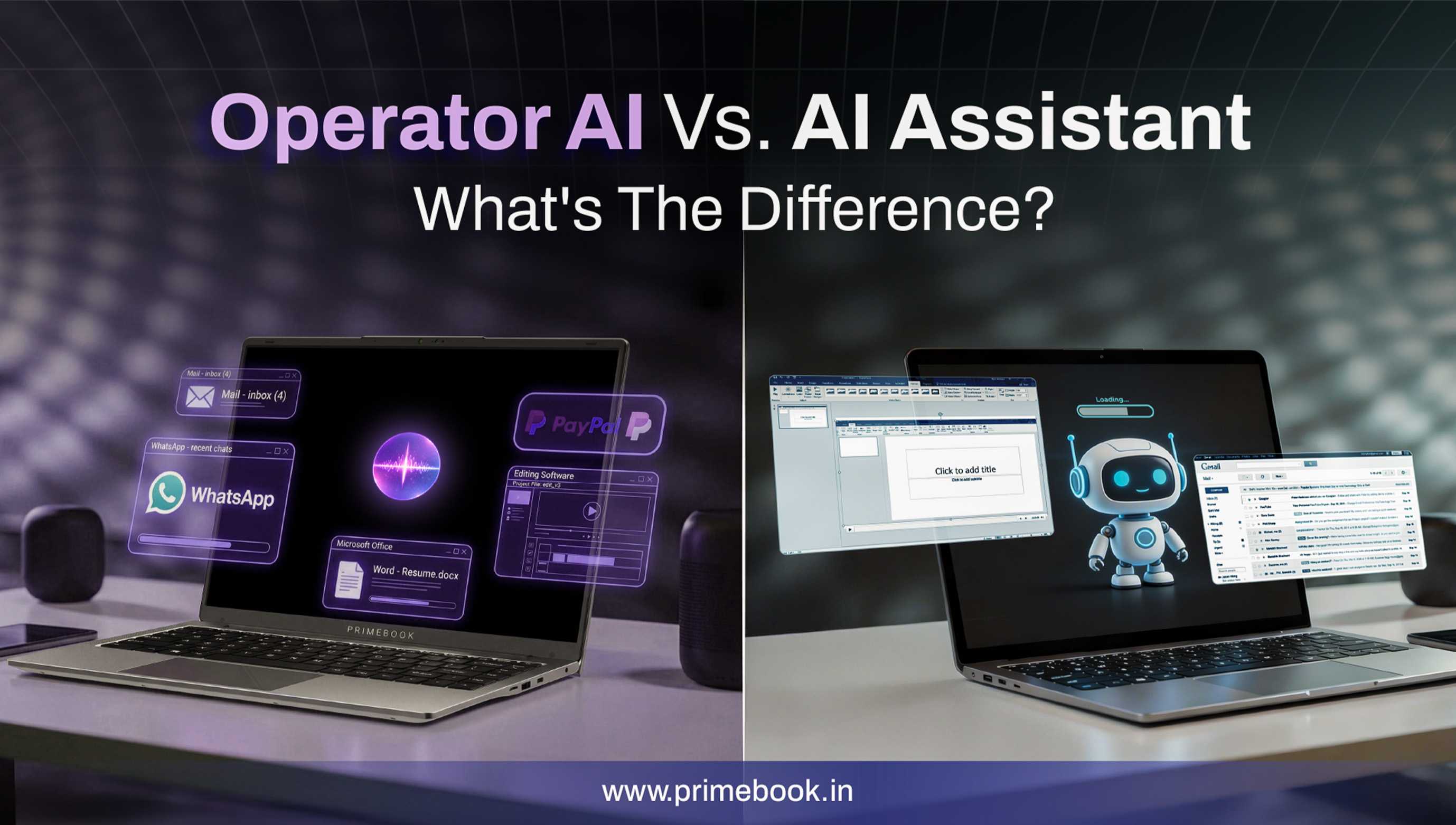
AI Assistant Vs. Operator AI: What's The Difference?

AI is no longer something people are trying out. It has already become part of how work gets done. According to Microsoft’s 2024 Work Trend Index, 75% of global knowledge workers now use AI at work.
Most of this usage today happens through AI assistants. They are used for researching topics, summarising information, creating presentations, writing content, and even basic design tasks. Their role, however, is still limited to responding to instructions.
Now, a different type of AI is starting to emerge, known as Operator AI. These systems are built to take complete action, not just assist. They can handle tasks, follow steps, and move work forward on their own.
This is where the difference between an AI Assistant and an Operator AI starts to matter and we are here to uncover the differences in the blog.
Difference Between AI Assistant and Operator AI
How a Task is Defined
-
AI Assistant: You define each step
-
Operator AI: You define the final outcome
Who Carries the Task Forward
-
AI Assistant: It completes the step you give it. But after that, you decide what to do next and move the task forward.
-
Operator AI: It does not stop at one step. It continues the task across multiple steps until the outcome is achieved.
For example: If you are preparing a report, an AI Assistant can help you research and write parts of it. But you still have to organise the content, format it, save it to your system, and then send it to whoever needs it. An Operator AI can handle the entire flow once you define the goal.
Where the AI Operates
-
AI Assistant: Works within a single tool or interface
-
Operator AI: Works across multiple apps and digital environments
Where AI Sits in the System
-
AI Assistant: Exists as a tool you open
-
Operator AI: Exists as a system-level capability
What Problem It Solves
-
AI Assistant: Reduces effort in specific parts of a task. It makes individual steps faster and easier, but the overall process still needs to be managed by you.
-
Operator AI: Reduces the need to manage the entire task. It handles the full process, so you don’t have to coordinate steps, tools, or transitions.
Understanding Context During Execution
-
AI Assistant: Works only on what you explicitly give it. It does not understand what is happening outside that prompt or across your system.
-
Operator AI: Understands what is happening across your system while the task is being performed. It can use that context to decide how the task should progress.
Nature of Computing
-
AI Assistant: Follows a task-based model. You break work into smaller tasks and complete them step by step with support from AI.
-
Operator AI: Follows an outcome-based model. You define what needs to be done, and the system handles the entire process to achieve that result.
How Your Time Is Used
-
AI Assistant: You have to stay involved while the task is being done. Your time and attention are tied to the process from start to finish.
-
Operator AI: Can run tasks in the background. Once the task is assigned, it continues while you focus on more important work, such as ideating on a campaign or solving a real problem with code.
Why This Shift Matters in Everyday Computing
This shift is not just about what Artifical Intelligence can do in 2026. It changes how people experience personal computing in day-to-day lives.
Most of your time today is not spent on meaningful work, but on managing tasks. Switching between apps, repeating steps, and making sure everything is done correctly. These are necessary, but they take time and attention away from what actually matters.
AI Assistants help reduce effort in parts of this process. But the overall experience still depends on how well you manage the workflow.
Operator AI changes that experience. They are built to handle repetitive workflows end-to-end. This means less time spent on coordination, and more time available for thinking, solving problems, or focusing on important work.
It also reduces small but critical errors that happen during manual execution. For example, sending the wrong file, missing a step, or forgetting to follow up. These are not complex problems, but they affect outcomes.
By handling execution at the system level, Operator AI make computing less about managing tasks, and more about achieving results.
Also Read: What is Agentic AI
To conclude, this shift is not about replacing one type of AI with another. It changes what it means to use a computer. For the first time, the system is not just something you operate; it starts operating for you. That changes how time, effort, and attention are used in everyday work.
This is where PrimeAGNT on Primebook, built into PrimeOS, comes in, redefining how personal computing is experienced and leveraged.