Blogs / Trendy Tech Talks / The Quiet Rise of Voice-First Computing for Bharat Users
Blogs / Trendy Tech Talks / The Quiet Rise of Voice-First Computing for Bharat Users

Primebook Team
29 Jun 2026
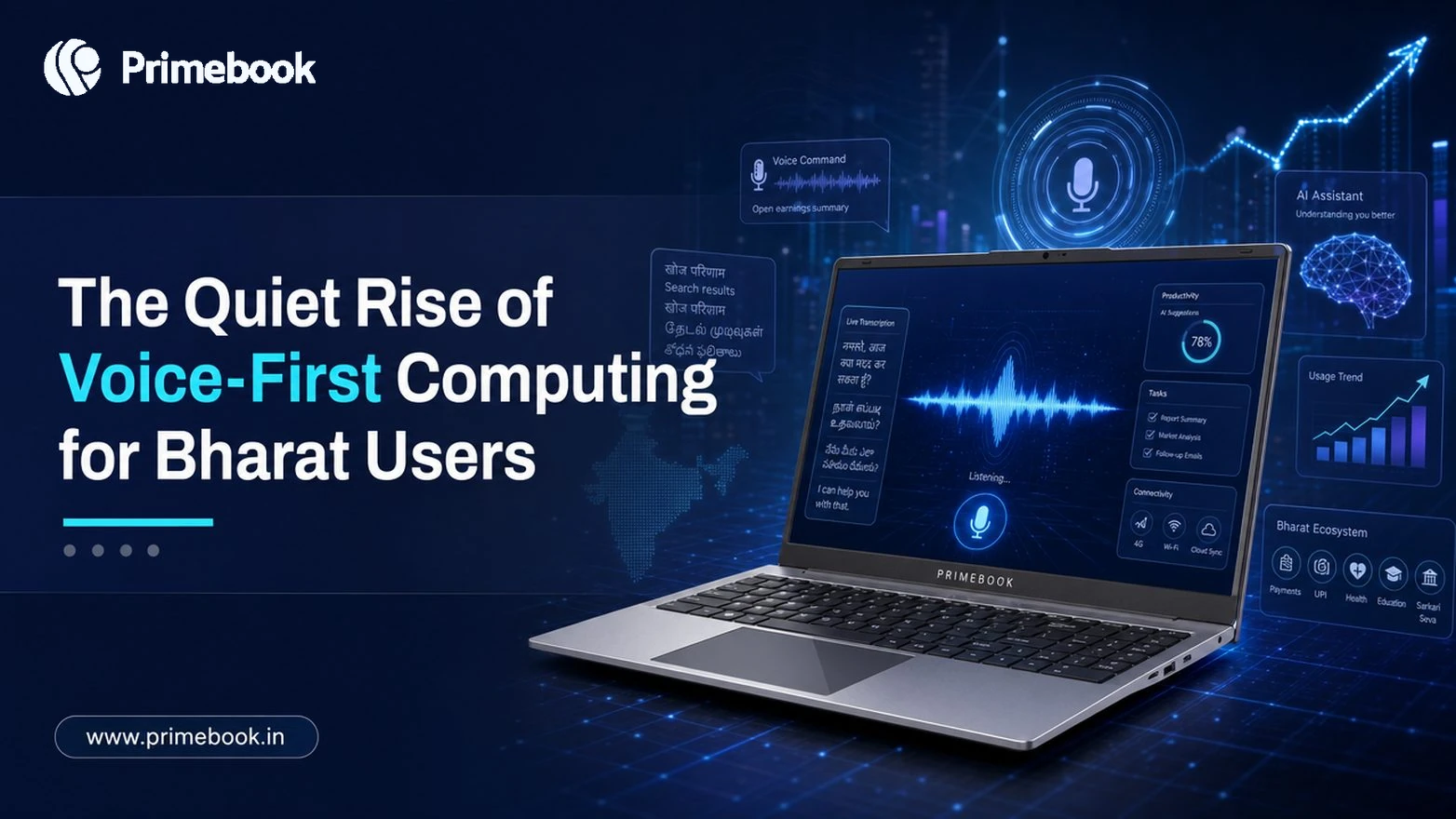
The Quiet Rise of Voice-First Computing for Bharat Users
Table of Contents
- Introduction
- What Voice-First Computing Actually Means for Bharat
- Why This Shift Is Happening Now
- Where Voice Is Quietly Replacing the Keyboard
- What It Changes for Device Makers and OS Design
- Conclusion
- FAQ
Introduction
Something interesting is happening in how the next wave of Indian users meets computing. They are not learning to type faster, switch tabs, or memorise app menus. They are talking to their devices in Hindi, Tamil, Bhojpuri, and a dozen other tongues, and expecting their devices to understand. Voice-first computing in india is no longer a Silicon Valley experiment adapted for the Indian market. It is becoming the default doorway for users who skipped the desktop era entirely.
The shift is quiet because it does not look like a launch event. It looks like a kirana owner dictating an invoice, a Class 9 student asking a question to NotebookLM in Marathi, or a gig worker confirming a payment by speaking into UPI. According to Northstar Digital research, 60% of current Indian AI users already interact via voice at least sometimes, and 59% have tried AI in a regional language. That is not a future trend. That is the present, only unevenly distributed.
What Voice-First Computing Actually Means for Bharat
Voice-first computing is not the same as having a voice assistant tucked inside a smartphone. The distinction matters. A voice assistant is a feature. A voice-first system is an interface design philosophy where speech is the primary input, the screen becomes confirmation, and typing becomes optional. For users whose first language is not represented well on a QWERTY keyboard, this is the difference between participation and exclusion.
Recent discussions around India's digital and AI policy have increasingly positioned voice-first, vernacular AI as a way to bring rural and small-town users into the formal digital economy. The phrasing is deliberate. Text-first interfaces have been a quiet filter for two decades, sorting users by English literacy and typing comfort. Voice removes that filter.
Why This Shift Is Happening Now
Three forces are converging in 2026 that did not exist together before. First, model quality. India-specific speech and language models have crossed a usability threshold, partly because of the government's India AI Mission backing eight foundational models trained on Indian data and a 570-lab AI Data Lab network. Indic ASR (automatic speech recognition) has improved significantly and now handles code-mixed Hinglish, regional accents, and Indian languages far more reliably than earlier generations.
Second, infrastructure investment. Google's Rs 1,24,500 crore AI hub in Visakhapatnam is being positioned as its largest AI bet outside the US, with voice and regional-language access as a stated priority. That kind of capex shapes which interfaces become cheap to deploy.
Third, market signal. India's Voice AI market is projected to grow from USD 580 million to USD 2.8 billion between 2024 and 2027. Commercial gravity is now pulling builders toward voice-native experiences rather than retrofitted ones.
Where Voice Is Quietly Replacing the Keyboard
These changes are already beginning to reshape everyday digital interactions across several sectors. The most visible move is in payments. Voice is emerging as the next frontier for digital payments, particularly for users with low textual literacy who currently rely on a family member to confirm transfers. Voice-enabled payment experiences have the potential to simplify what is currently a multi-step UPI interaction into a more natural conversational flow.
Customer service is the second front. EY's 2026 outlook on agentic AI notes that 2026 marks a shift toward voice-first interaction wherever real-time communication is essential. Field operations, frontline workflows, and grievance redressal are being rebuilt around voice because the alternative, a typed support ticket in English, was never going to scale to the next 400 million users.
Education is the third, and the most interesting. Students in tier-3 towns are increasingly using voice to query AI tutors in their mother tongue, then reading the response on screen. The keyboard becomes irrelevant to the learning loop.
What It Changes for Device Makers and OS Design
A voice-first paradigm reshapes what a personal computer should be. Microphone array quality, low-latency on-device inference, and OS-level access for voice agents move from nice-to-have to baseline. The legacy laptop, designed around a keyboard-first user, starts to look like a translation of an older era. Android-based systems may hold a structural advantage here because they inherit a mobile-first voice stack that has evolved around multilingual and voice-led mobile usage.
As voice becomes a primary interface rather than an added feature, operating systems will increasingly be judged by how naturally they support multilingual, conversational interactions across everyday applications, rather than by traditional desktop workflows alone.
Also Read:
- Latest AI Trends in India (2026): The Rise of AI that Completes Tasks Across Apps and Websites
- What is Operator AI? How AI is Moving from Assistance to Execution?
- From 2G to 4G to 6G Network: India's Connectivity Journey!
Conclusion
Voice-first computing is not arriving with a banner. It is arriving in the small, invisible moments where a user who would have walked away from a typed form now completes a transaction by speaking. The interesting question for 2026 and beyond is not whether voice will scale. It already is. The question is which operating systems, devices, and apps will be designed natively around it, and which will keep treating it as an accessibility add-on. The first group will define how Bharat computes. The second will keep wondering why their adoption numbers stalled.
FAQ
What is voice-first computing?
Voice-first computing is an interface design where speech is the primary way users interact with a device, and the screen serves mostly as confirmation. It differs from having a voice assistant feature inside an otherwise keyboard-and-touch system.
Why is voice-first computing especially relevant in India?
India has hundreds of millions of users whose first language is not well represented on a standard keyboard, and many are first-generation digital users. Voice removes the literacy and typing barriers that have historically filtered who can participate in the digital economy.
Is voice-first computing already mainstream in India?
Among current AI users, yes. Research from Northstar Digital shows 60% already use voice at least sometimes and 59% have tried AI in a regional language. Across the broader population, adoption is uneven but rising sharply through 2026.
Editorial Transparency: Primebook's editorial team uses a combination of human expertise, research, and AI-powered tools to create and refine content. Every article is reviewed and validated by our team before publication to ensure accuracy, clarity, and usefulness for readers.
 Related Blog