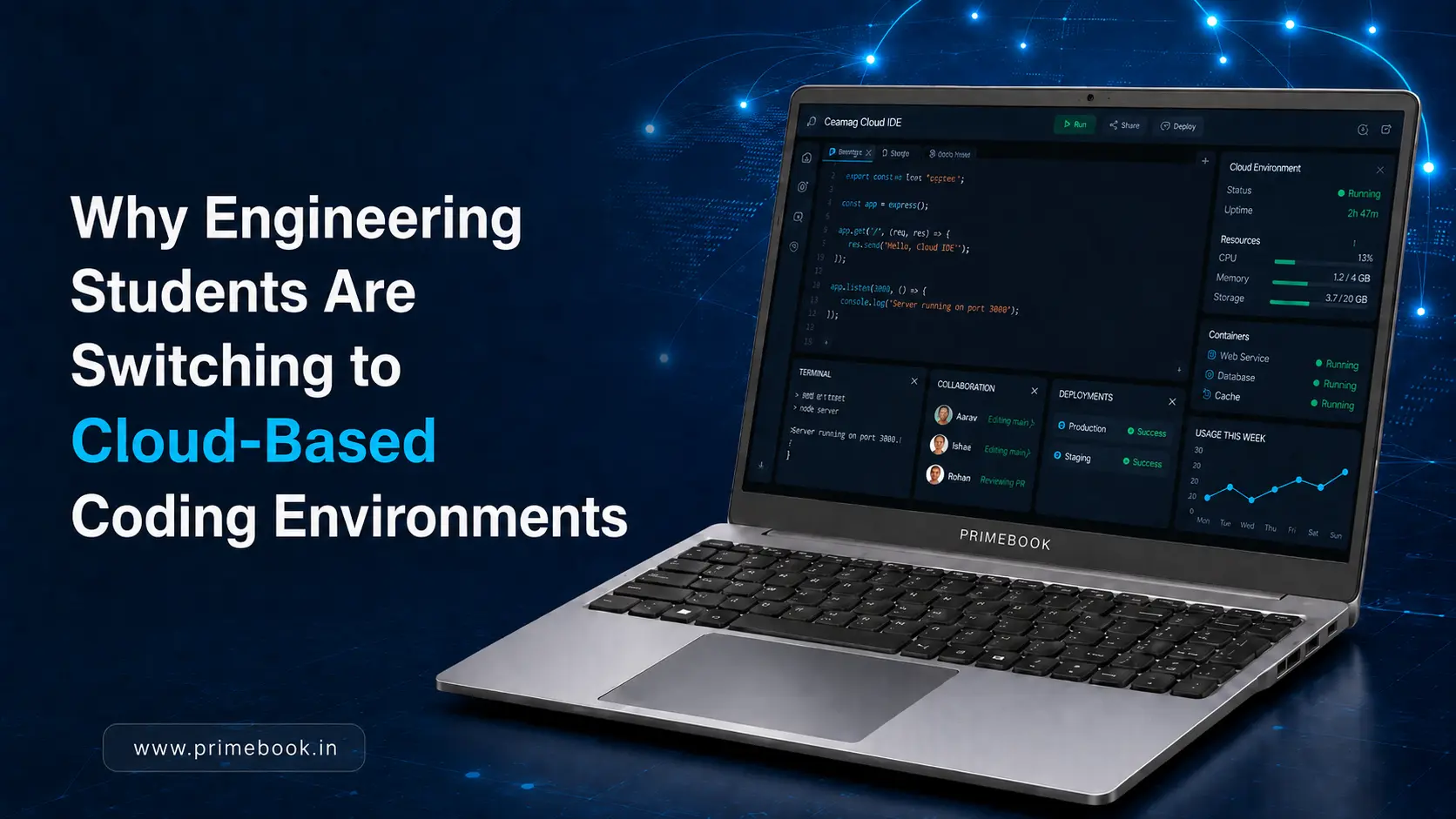
Why Engineering Students Are Switching to Cloud-Based Coding Environments

Table of Contents
- Introduction
- The Setup Problem in Indian Engineering Labs
- What Cloud Coding Actually Means for Students
- Why the Shift is Happening Now
- How Workflows Are Changing Across Campuses
- Trade-Offs Students Should Weigh
- Conclusion
- Frequently Asked Questions
Introduction
Walk into any first-year engineering lab in India and the first hour rarely involves writing code. It involves installing it. Compilers refuse to load on older machines, IDE versions clash with operating system updates, and shared lab desktops carry the fingerprints of every batch that came before. By the time the environment works, the practical session is half over.
This friction is exactly why cloud coding for students has moved from a niche experiment to a structural shift in how computer science and allied branches are taught in India. Browser-based development environments are now part of curriculum design at private engineering colleges, government skilling programmes, and national hackathon circuits. The change is not driven by hype. It is driven by a measurable gap between what a student's machine can do and what their syllabus expects.
According to a 2022 study presented at the IEOM India conference, a cloud-based coding lab for undergraduate programming courses increased lab completion rates by 23.8% and reduced environment-setup issues by 37%. Numbers like these are reshaping how Indian institutions think about coding pedagogy.
The Setup Problem in Indian Engineering Labs
The traditional engineering coding workflow assumes a stable, well-configured local machine. In reality, most students arrive with mixed hardware: some on entry-level laptops, some sharing devices with siblings, some relying entirely on campus systems. Configuring a heavy IDE, a database server, and a project framework on each of these machines is a different problem each time.
The IEOM India research captured the cost of this fragmentation precisely. In traditional labs, students typically spent 30 to 45 minutes installing compilers and IDEs, while those on a browser-based lab were writing their first lines of code within 3 to 5 minutes of login. Multiply that across a semester of weekly practicals and the lost teaching hours are significant.
The MRI India journal on online IDEs adds a second dimension: institutions are piloting browser-based platforms because they offer consistent environments independent of device hardware, particularly where many students use lower-spec laptops or shared campus systems. A consistent environment means the lecturer's demo behaves the same way on every student's screen, which removes a hidden but constant source of confusion.
What Cloud Coding Actually Means for Students
Cloud coding for students refers to writing, compiling, and running code through a browser, where the compute and storage live on a remote server rather than the local device. There is no installation, no version mismatch, and no dependency on the laptop's processor for anything beyond loading a web tab.
The categories students typically encounter include:
- Online IDEs: browser-based editors that handle multiple languages and frameworks in one window.
- Cloud labs operated by institutions: virtualised environments provisioned by the college itself, with pre-configured projects and datasets.
- Cloud-native development sandboxes: platforms tied to providers like AWS, where students learn to build and deploy directly on the same infrastructure used in industry.
A 2025 explainer on cloud IDEs in Indian colleges notes that these tools reduce the need for strong personal hardware and allow coding from almost anywhere with internet access. For a student dividing time between hostel, home, and campus, this portability matters more than benchmark scores.
Why the Shift is Happening Now
As internet connectivity, browser performance, and managed cloud development platforms have improved, three forces have converged to accelerate cloud adoption in engineering education, and all three are now visible in 2026 curriculum decisions.
First, institutional buy-in. A feature on the NIAT Cloud Lab Experience 2026 describes B.Tech computer science streams moving to a virtualised, high-performance cloud lab accessible 24/7, explicitly to overcome the bottleneck of limited physical labs and let students run AI, data, and distributed systems workloads without high-spec personal laptops. When colleges invest at this scale, the rest of the curriculum aligns.
Second, formal integration with cloud providers. A 2020 report on Indian engineering colleges documented that several institutes have embedded AWS cloud computing into their core programmes, with faculty training and student labs delivered on cloud consoles. By 2026, this is no longer experimental. The National Institute of Electronics and Information Technology has launched a 90-hour Cloud Native Engineering course with AWS, Docker and Kubernetes that expects students to deploy directly in cloud-native setups.
Third, the hackathon and contest circuit. Cloudathon 2026 and Google Cloud's hackathon series across 100 engineering colleges require participants to build and deploy on cloud platforms. Students preparing for these events naturally adopt cloud-based toolchains months in advance. This shift also mirrors industry hiring trends, where graduates are increasingly expected to deploy, collaborate, and work within cloud-native environments from day one.
How Workflows Are Changing Across Campuses
The shift is most visible in three workflows that engineering students repeat constantly.
Real-time collaboration is one of the clearest gains. The MRI India journal highlights that shared coding sessions allow multiple learners to edit the same code and see changes instantly, which directly supports group mini-projects and hackathon teams that need to iterate quickly.
For students interested in deeper context on how cloud computing is being absorbed into Indian education broadly, the broader landscape is covered in this read on how cloud PCs are transforming learning for students and educators in India.
Trade-Offs Students Should Weigh
Cloud-based coding is not a universal solution. Engineering students should think carefully about three trade-offs before committing fully.
- Internet dependency: A browser-based IDE is only as reliable as the connection behind it. Students in low-bandwidth regions may face inconsistent practical sessions.
- Vendor familiarity: Specialising too early in one provider's console can shape habits that do not translate cleanly across platforms. A 2026 roadmap for engineers points out that with multi-cloud strategies becoming standard for large organisations, exposure to more than one environment is more useful than mastery of just one.
- Foundational understanding: Cloud tooling abstracts away how compilers, networks, and operating systems actually work. Students should still spend time understanding the layers underneath, even if their day-to-day coding happens in the browser.
The right approach is selective. Use cloud environments where they remove friction (assignments, group projects, deployment), and keep local setups for the conceptual work that requires touching the system directly.
Conclusion
The move to browser-based coding among engineering students reflects a deeper change in how Indian institutions are designing their programmes for a multi-cloud, deployment-first industry. The decision a student faces is no longer whether to use cloud tools, but how to combine them with traditional foundations so neither side becomes a blind spot. Engineering education in 2026 rewards those who can switch fluidly between a configured local machine and a browser tab spinning up production infrastructure. Choosing one camp permanently is a narrower path than the syllabus, the recruiters, and the hackathons now expect. The next phase may extend beyond browser-based IDEs into AI-assisted cloud workspaces, remote lab infrastructure, and curriculum designs built entirely around cloud-native development.
Also Read: Best Laptop for Cloud Computing
Frequently Asked Questions
Is cloud coding only for computer science students?
No. Electronics, mechanical, and electrical streams increasingly use cloud labs for simulations, data analysis, and embedded project work. The NIELIT cloud-native programme and AWS-integrated curricula are open to students across engineering disciplines, not just CSE.
Do I still need a capable laptop if I use cloud coding tools?
You need a reliable laptop that can run a modern browser smoothly and handle stable video calls. The heavy lifting moves to the cloud, but the device still has to manage your daily browsing, documents, and collaboration tools without slowing down.
Will using cloud IDEs hurt my fundamentals?
Only if you use them as a shortcut. Cloud IDEs handle environment setup, but they do not replace learning about memory, algorithms, or operating systems. Treat them as a workflow tool and pair them with a conceptual study from your syllabus and standard textbooks.
How important is cloud experience for engineering placements in 2026?
As cloud-native development becomes more common in engineering curricula, hackathons, and internship programmes, recruiters increasingly value candidates who can deploy applications, collaborate in cloud environments, and understand basic infrastructure concepts.
Editorial Transparency: Primebook's editorial team uses a combination of human expertise, research, and AI-powered tools to create and refine content. Every article is reviewed and validated by our team before publication to ensure accuracy, clarity, and usefulness for readers.