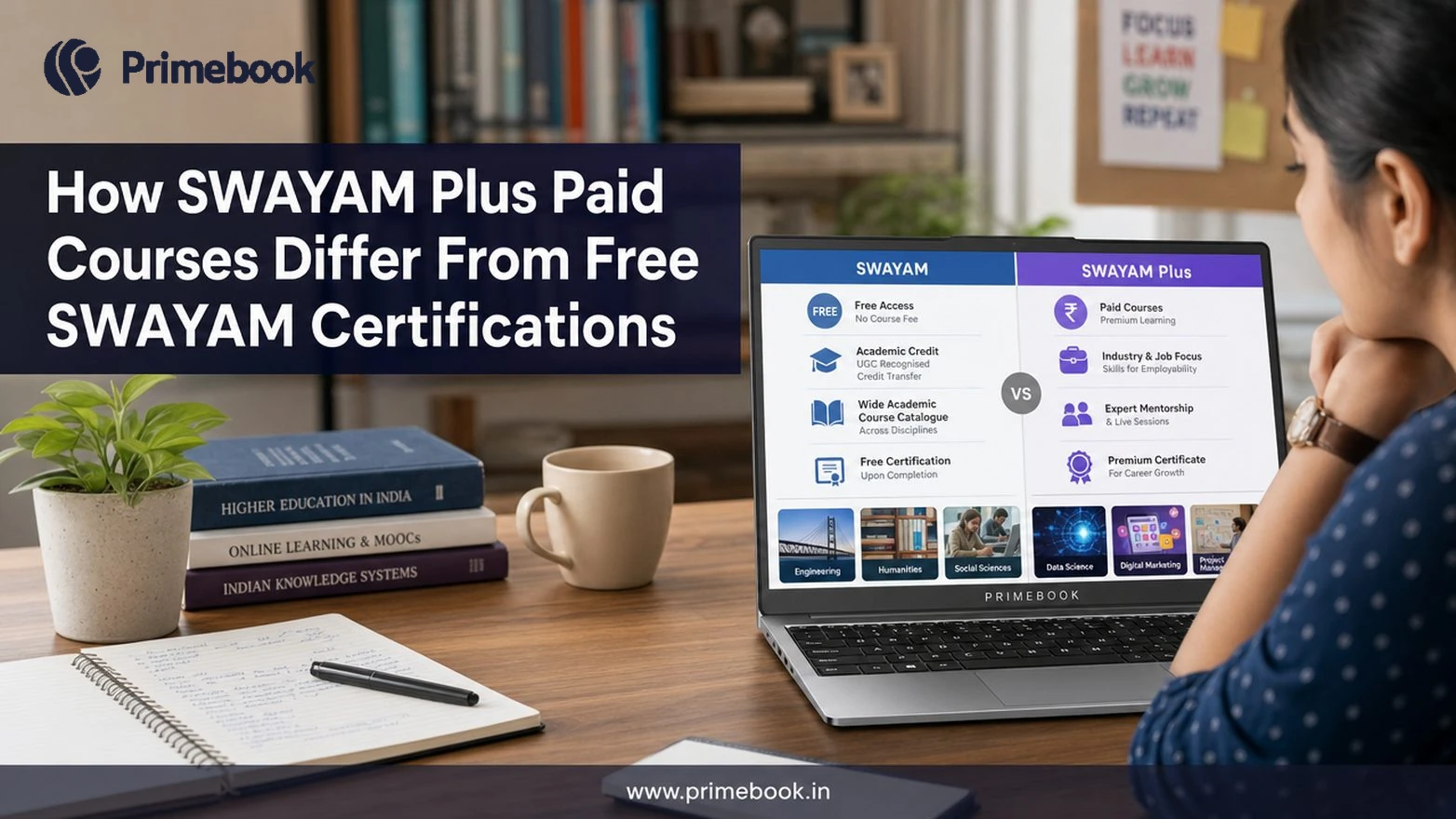
How SWAYAM Plus Paid Courses Differ From Free SWAYAM Certifications

Table of Contents
- Introduction
- Core Cost Structure: What You Actually Pay For
- Certification Purpose: Academic Credit vs Employability
- Course Catalogue and Level Coverage
- Quick Comparison: SWAYAM Plus vs SWAYAM
- Choosing the Right Platform for Your Goal
- Conclusion
- Frequently Asked Questions
Introduction
The Ministry of Education runs two learning portals that look similar on the surface but solve very different problems. SWAYAM has been India's flagship MOOC platform since 2017, offering free academic courses from Class 9 to postgraduate level. SWAYAM Plus, launched in February 2024 and operated by IIT Madras, sits alongside it as a skilling and employability portal built with industry partners.
Although SWAYAM and SWAYAM Plus belong to the same ecosystem, they are designed for different outcomes. Choosing the wrong platform can leave learners with a course that doesn't align with their academic or career goals. A student looking for a credit-bearing course sometimes ends up on a paid skilling module. A working professional chasing an industry-recognised credential lands on a free semester-style course that does not match their goal. The SWAYAM Plus vs SWAYAM decision isn't about which platform is better; it's about understanding whether your goal is academic learning, credit transfer, or career-focused upskilling.
This guide breaks down the real differences: what you pay, what you get, and which platform is built for your outcome.
Core Cost Structure: What You Actually Pay For
The cost logic is where the two platforms diverge most clearly. On the SWAYAM portal, all courses are free to access. You pay only if you want a certificate, and that fee covers a final proctored exam at a designated centre. Public information summarising SWAYAM exam fees shows typical charges in the ₹500 to ₹1,000 range per course, depending on category.
SWAYAM Plus follows a different pricing model. The course itself carries a fee because the content is built with industry partners rather than academic coordinators. An independent analysis of the SWAYAM Plus catalogue found that 43% of the available courses were paid, with paid course prices ranging from ₹9 to ₹20,000 and a median fee of ₹2,500. The rest remain free, but the paid tier is where the industry-recognised programmes sit.
Certification Purpose: Academic Credit vs Employability
The value of a certificate depends on what you want to achieve with it. SWAYAM certificates are designed to slot into formal education. Universities can earmark SWAYAM courses as credit-eligible, and learners who clear the proctored exam can transfer those credits into their degree programme. This is why the portal covers courses from Class 9 through postgraduate level, prepared by AICTE, UGC, NPTEL, IGNOU and NCERT.
SWAYAM Plus is not built for that pathway. It is explicitly positioned as an employment-oriented skilling portal, delivering short, modular courses in collaboration with technology firms and sector partners. The credential you earn is a micro-credential, useful on a CV or LinkedIn profile, not a semester credit.
If your priority is earning academic credits or supplementing university studies, SWAYAM is the better fit. If your goal is gaining practical, industry-relevant skills that strengthen your employability, SWAYAM Plus is designed for that purpose.
Course Catalogue and Level Coverage
Scale is another point of separation. SWAYAM has grown into one of the largest MOOC platforms globally, with over 14,000 courses and millions of enrolments across school and higher education. The catalogue mirrors classroom teaching, with lectures, readings, quizzes and discussion forums organised into semester-length structures.
SWAYAM Plus is deliberately smaller and more curated. Within a year of launch, SWAYAM Plus had grown to over 500 courses offered by dozens of industry and academic partners, focused on graduates and working professionals rather than school students. Courses are short, modular, and taught by a mix of academic faculty and industry practitioners. The catalogue focuses on practical skills that employers actively look for across technology, business, and emerging industries.
Quick Comparison: SWAYAM Plus vs SWAYAM
Choosing the Right Platform for Your Goal
The SWAYAM Plus vs SWAYAM question resolves quickly once you name your outcome. If you are an undergraduate looking to transfer credits, strengthen a weak subject, or explore an academic discipline before choosing a specialisation, SWAYAM is the fit. Registration is free, exam fees are small, and the courses map to formal curricula.
If you are a graduate, early-career professional, or freelancer looking to add a specific job-ready skill (data tools, digital marketing, product basics, coding fundamentals), SWAYAM Plus is the fit. The paid programmes are developed with industry partners and focus on workplace-ready skills that complement traditional academic qualifications.
Registration flow differs slightly too. SWAYAM lets you sign up and start immediately. For SWAYAM Plus, you need a SWAYAM profile first, and then additional details (education level, current year) before you can access Plus courses, reflecting the platform's focus on graduates and early-career professionals.
Also Read:
- Free Digital Marketing Course by Government of India
- Schemes for Free Education by The Government of India
Conclusion
Government-backed online learning in India has matured into an ecosystem rather than a single destination. Instead of trying to serve every learner with one model, different platforms now address different stages of education and employment. Choosing the right one means treating online courses as purposeful investments rather than simply collecting certificates.
Frequently Asked Questions
Can I use both SWAYAM and SWAYAM Plus at the same time?
Yes. SWAYAM and SWAYAM Plus are complementary platforms rather than alternatives. You can take academic courses on SWAYAM while enrolling in industry-focused programmes on SWAYAM Plus, depending on your learning goals.
Do I need to complete a SWAYAM course before using SWAYAM Plus?
No. You do not need to complete a SWAYAM course first. However, you must create a SWAYAM account before accessing SWAYAM Plus, after which you can complete the additional profile details required for the Plus platform.
How long do SWAYAM Plus courses usually take to complete?
SWAYAM Plus course durations vary depending on the programme. Most courses are designed to be shorter and more modular than traditional semester-long courses, with many requiring 30 to 70 hours of learning. Depending on the pace and schedule set by the course provider, learners can typically complete them over a few weeks to a couple of months. Always check the course details before enrolling, as duration differs across programmes.
What happens if I don't complete a SWAYAM Plus course?
If you don't complete the course requirements or assessments within the specified timeline, you may not receive a certificate. Depending on the course provider, you may need to re-enrol or wait for the next offering to complete the programme.
Editorial Transparency: Primebook's editorial team uses a combination of human expertise, research, and AI-powered tools to create and refine content. Every article is reviewed and validated by our team before publication to ensure accuracy, clarity, and usefulness for readers.