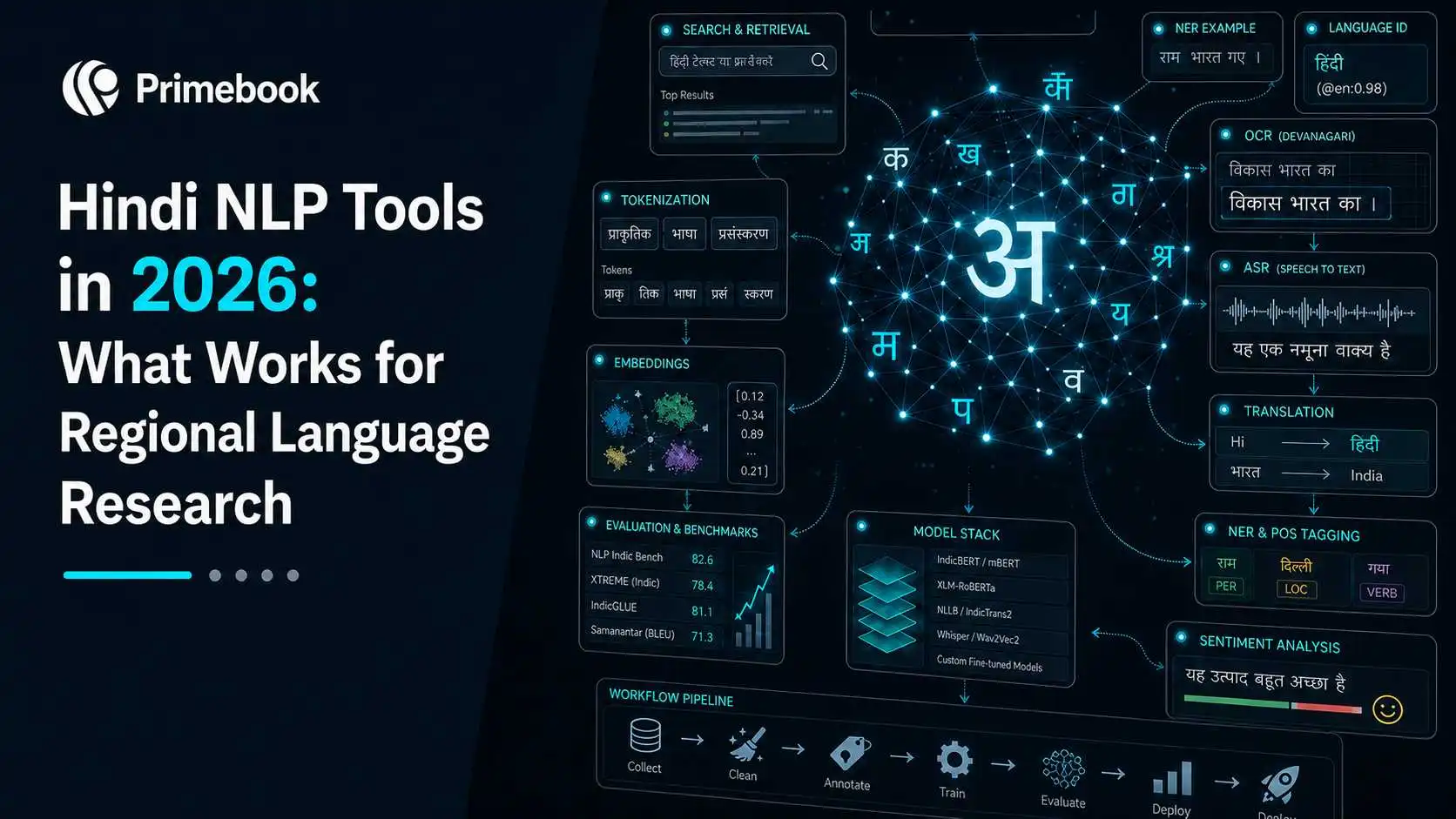
Hindi NLP Tools in 2026: What Works for Regional Language Research

Table of Contents
- Introduction
- Why Hindi NLP Research Has Shifted in 2026
- What Actually Works: Tools and Stacks Worth Studying
- Building a Hindi NLP Research Workflow
- Gaps, Limits, and Honest Constraints
- How Students Can Start Their Own Research
- Conclusion
- Frequently Asked Questions
Introduction
Hindi sits at an awkward point in the global NLP map. It has more than half a billion speakers, yet for years the research stack around it felt thin compared with English. That gap is narrowing fast in 2026, but it is narrowing in specific places, not everywhere at once. If you are a student or early researcher trying to figure out which hindi nlp tools 2026 actually deserve your time, the honest answer depends less on hype and more on what task you are solving.
The shift this year is structural. Indian-language NLP is no longer just a translation problem or a sentiment-analysis demo. It now spans document OCR, code-mixed speech, multilingual embeddings, and culturally grounded benchmarks. According to the BhashaSutra survey on Indian-language NLP, the ecosystem currently spans more than 200 datasets, 50 benchmarks, and 100 models, tools, and systems across tasks. That is a larger ecosystem than most students realise, but it is still highly fragmented.
This guide is for students writing dissertations, building prototypes, or trying to publish their first regional-language paper. It maps what works and where serious research gaps still sit.
Why Hindi NLP Research Has Shifted in 2026
For a long time, Hindi NLP meant retraining English-first architectures on whatever Hindi text could be scraped. The output worked for clean Devanagari news copy and broke on almost everything real, like WhatsApp messages, Hinglish reviews, voice queries, and scanned documents. The 2026 turn is that Indian-language work is finally being designed around how Hindi is actually used in the country, not how it appears in textbooks.
Two forces are driving this. First, Modern multilingual models can learn patterns across many languages at once, making it easier to build Hindi NLP systems without collecting massive Hindi-only datasets. Research from IndiaAI on Microsoft's Turing Multilingual Language Model (T-ULRv2) notes that 94 languages can now be represented within the same multilingual system, which means a Hindi researcher does not have to rebuild every pipeline from scratch. Second, document-heavy use cases are improving. Future Market Insights reports that Sarvam Vision, launched in February 2026, hit 84.3% accuracy on Indian-language document processing benchmarks, outperforming frontier models such as Gemini 3 Pro on those specific tasks.
The growing ecosystem also means students now have access to more datasets, benchmarks, and open-source models than they did just a few years ago, making Hindi NLP research significantly more accessible.
What Actually Works: Tools and Stacks Worth Studying
Picking hindi nlp tools 2026 is less about ranking and more about matching the tool to the task. Document-level work, voice work, and code-mixed text each demand different stacks, and choosing wrong wastes months of a research timeline.
An industry breakdown by Rajesh R Nair on building Hindi and Malayalam AI recommends starting with rule-based automation for high-volume repetitive tasks before layering in chatbots, transcription, and custom API integration. That ordering is sensible for student researchers because it isolates where errors come from.
For voice-driven Hindi work, a 2026 industry note on Hindi voice shopping highlights that modern Hindi voice systems increasingly separate speech recognition from understanding. One layer converts speech into text, while another interprets what the user is actually trying to do. This approach tends to work better for code-mixed Hindi and English inputs. The lesson for research is the same: do not collapse speech recognition and intent understanding into one model unless your benchmark explicitly demands it.
Building a Hindi NLP Research Workflow
A workable research workflow in 2026 looks less like one heroic model and more like a chain of small, debuggable parts. There is a practical reason for this. The BhashaSutra survey explicitly maps the field across text, speech, multimodal, and culturally grounded tasks, which tells you that any serious Hindi NLP paper now needs evaluation on more than one dimension to be credible.
A reasonable structure for a student project looks like this. Begin with a clearly scoped problem, ideally tied to a real Indian use case such as legal document parsing, agricultural advisory chat, or classroom Q and A. Pick one primary dataset and one secondary benchmark, ideally drawn from the existing 200-plus Indian-language datasets the survey catalogues. Choose your tooling by task, not by trend, using the table above as a starting reference. Build a baseline using rule-based or classical methods before introducing transformer models, so the gain from each layer is visible.
Evaluation is where most regional-language papers lose marks. Generic accuracy on a clean test set says very little about whether the system handles real Hindi. Add at least one stress test: code-mixed inputs, noisy OCR, dialectal variation, or low-resource subdomains. Real-world NLP systems increasingly need to handle messy inputs such as scanned documents, code-mixed language, and dialectal variation rather than only clean benchmark datasets.
Gaps, Limits, and Honest Constraints
It is worth being clear about what the current generation of hindi nlp tools 2026 does not solve well. Culturally grounded reasoning, long-form Hindi summarisation with domain accuracy, and reliable handling of low-resource dialects remain open problems. The headline benchmarks rarely test these, which means progress reports overstate the field's readiness.
Resource fragmentation is the other quiet constraint. With 200-plus datasets and 50-plus benchmarks scattered across academic and industry sources, students often spend weeks just locating the right corpus and licence. For a researcher, the practical takeaway is to over-document. Cite the dataset version, the preprocessing script, and the evaluation split. Reproducibility is where regional-language research currently wins or loses credibility, and most reviewers in 2026 are explicitly checking for it.
How Students Can Start Their Own Research
If you are at the start of a Hindi NLP project and not sure where to plant your first step, the smarter move is to narrow the question before touching any model. A focused question like "how well do open multilingual models extract entities from Hindi legal notices" is a stronger thesis seed than "Hindi NLP for legal tech." Specificity is what makes a small student project publishable.
From there, anchor yourself to the survey landscape. The full BhashaSutra paper is a useful index for choosing datasets and benchmarks that have already been peer-vetted. Pick tools that match the task table earlier in this article, and resist the urge to layer in a frontier LLM just because it is available. A clean baseline with rule-based parsing and a single fine-tuned multilingual model often produces a more interesting paper than a maximalist stack.
Practical study workflows for this kind of project benefit from the same discipline as exam preparation. Students researching alongside coursework may find general study and workflow guides on using Google Scholar for academic research or structured data science learning platforms useful for organising the surrounding skill set. For applied AI context, the broader survey of AI agent types in 2026 sets a wider frame around where NLP sits inside today's AI systems.
Conclusion
Hindi NLP in 2026 is not one tool, one model, or one breakthrough. It is a maturing surface where the best research now comes from matching the right method to a clearly defined task, then evaluating it under conditions that resemble real Indian usage. The students who will publish meaningfully this year are the ones treating regional-language NLP as an engineering and linguistic problem at once, not just a benchmark race. The field has finally given you enough datasets, models, and shared embeddings to build something serious. The interesting work is now in how carefully you choose, combine, and stress-test them.
Frequently Asked Questions
Which Hindi NLP tool should a student start with in 2026?
Start with the task, not the tool. For text classification and entity work, open multilingual embedding models are a sensible baseline. For document or OCR tasks, Indian-language vision-language systems perform better than generic frontier models on Devanagari layouts.
Is it still worth using rule-based methods for Hindi NLP research?
Yes, especially as a baseline. Rule-based pipelines are cheaper, auditable, and make it clear where a neural model is adding value versus where it is just adding cost. Industry guides on Indian-language automation consistently recommend this layered approach.
What is the biggest weakness in current Hindi NLP systems?
Culturally grounded reasoning, dialectal coverage, and reliable handling of code-mixed Hinglish remain weak. Most public benchmarks do not stress-test these dimensions, so headline accuracy numbers tend to overstate real-world readiness.
How important are multilingual embeddings for Hindi research?
Very important. Shared multilingual vector spaces, such as the T-ULRv2 family covering 94 languages, mean Hindi researchers learn from patterns found in related languages instead of building every component from scratch. This is particularly useful for low-resource subtasks.
Where can students find vetted Hindi datasets and benchmarks?
The BhashaSutra survey is a strong starting index, cataloguing over 200 datasets and 50 benchmarks across Indian-language NLP tasks. Pairing one primary dataset with one secondary benchmark from this landscape is a reasonable structure for a student-scale project.