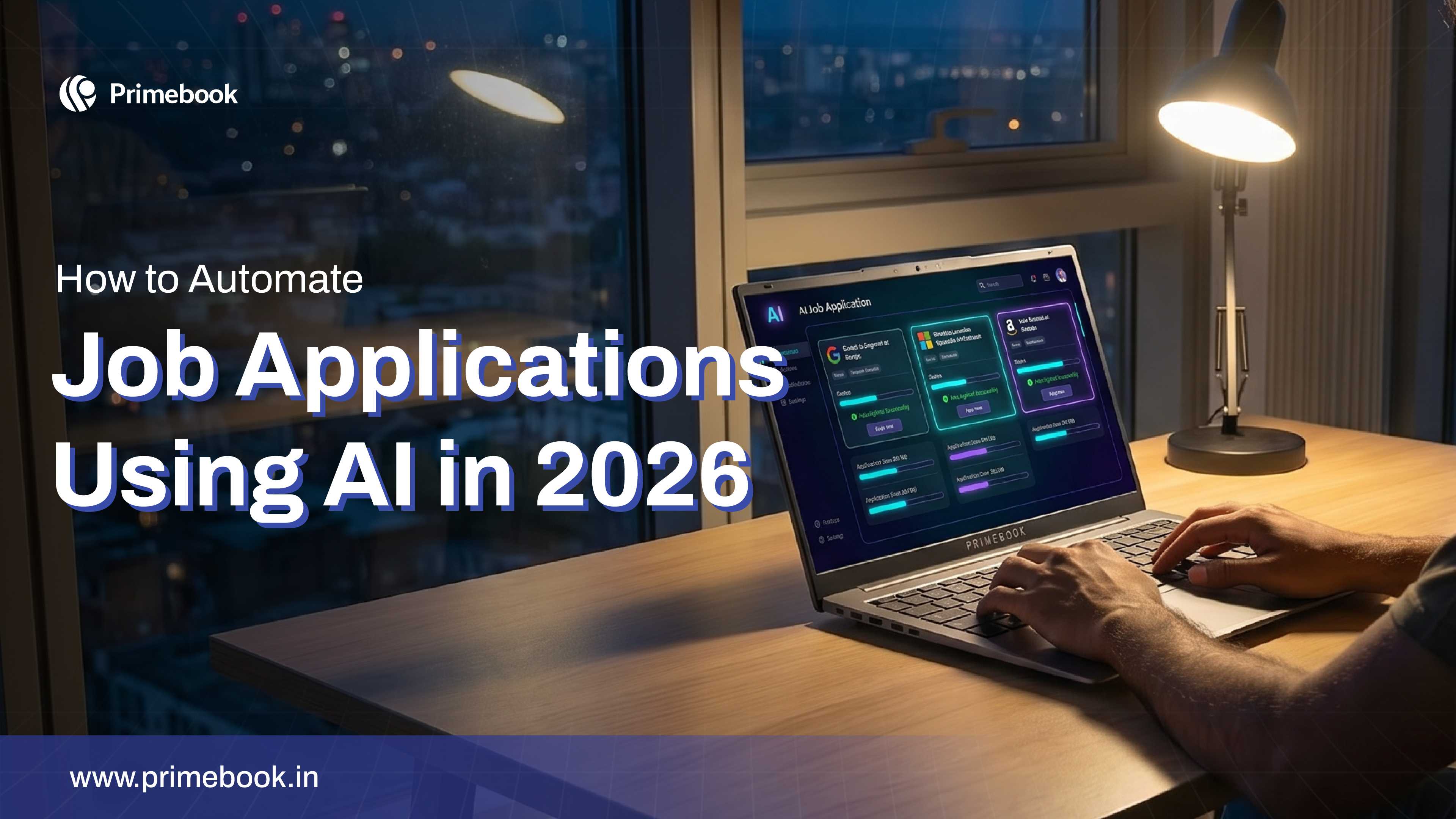
How to Automate Job Applications Using AI in 2026

Job searching today is no longer just about finding opportunities. It is about keeping up with the speed and scale at which applications are happening.
Recent data from Virtue Market Research shows that AI-driven job search tools have seen a 60% rise in adoption, with nearly 80% of job seekers reporting faster and more relevant job matches. This clearly shows that AI is already improving how people discover opportunities.
However, discovery is only one part of the process. Each application still requires reading job descriptions, tailoring resumes, writing cover letters, filling out forms, and tracking progress. Even with AI, most of this still happens step by step, repeated for every role you apply to.
In this blog, we break down how job applications actually work as a workflow. We also explore how AI in 2026 can move beyond assisting individual steps to automating the entire process from search to submission, removing the need for constant manual intervention.
How Job Applications Actually Work as a Workflow
Job applications often feel different because the roles, companies, and requirements change. But the way each application is handled usually follows the same structure.
For example:
A job is found → you read the description → identify what the role requires → match it with your experience → update your resume → write a cover letter → fill in the application form → submit → track the status
This flow repeats across almost every application. The inputs may vary. The structure does not.
Each step depends on the one before it, forming a connected process rather than isolated actions. What appears as multiple tasks is actually a single workflow that moves from discovery to submission and tracking. This is how job applications operate in practice.
Also Read: How to Automate Repetitive Tasks Using AI in 2026
How AI Is Used in Automating Job Applications Today & Where It Falls Short
AI is already playing a significant role in automating parts of the job application process.
Today, AI-powered job search platforms can:
-
Identify relevant roles based on your profile
-
Match your skills with job requirements
-
Recommend opportunities across multiple platforms
At the same time, AI assistants are widely used to:
-
Summarise job descriptions
-
Tailor resumes for specific roles
-
Generate cover letters and application responses
Together, these systems have made both discovery and preparation faster and more efficient. In many cases, they reduce the time spent on individual steps and improve the quality of applications.
However, you still have to:
-
Move between job platforms, documents, and tools
-
Decide how each application should be customised
-
Transfer information across systems
-
Complete submissions and track progress manually
In short, each step may be assisted or partially automated. But these capabilities remain isolated within specific parts of the flow. The responsibility of connecting these actions and ensuring completion still remains with you.
Also Read: What is Agentic AI
How Job Application Automation Changes in 2026
Job application automation in 2026 shifts from assisting parts of the process to handling the full flow as one connected system. This is made possible by systems often referred to as Operator AI, which are designed to execute tasks across workflows rather than assist within individual stages.
The operation begins with a defined goal, such as applying to relevant roles within a specific domain. From there, the system handles the flow in sequence. It:
-
Identifies suitable roles based on your profile
-
Understands what each role requires
-
Adjusts your resume and application content accordingly
-
Completes applications across platforms
-
Maintains a record of submissions and status
-
Adapts future applications based on previous outcomes
All of this happens as part of a single sequence of actions, where each step is executed in order. This allows applications to be completed consistently at scale, without needing to restart the process for each role.
Also Read: Different Types of AI Agents (2026)
How to Automate Job Applications Using AI
In 2026, automating job applications does not require setting up tasks in sequence. Instead, it begins with clearly defining what you want to achieve and allowing the system to handle the execution.
Here’s how it works:
Step 1: Define the outcome
Start by focusing on the result, not the process.
For example:
-
Apply to relevant product management roles this week
-
Find remote design jobs and submit tailored applications
-
Apply to entry-level roles based on your current skills
You specify the outcome and let the system determine how it can be achieved.
Step 2: Give a simple instruction
Provide a clear instruction using text or voice.
For example: Hi AI, find relevant jobs for me on Indeed, apply with customised resumes and cover letters, and notify me once done.
This acts as the starting point for the system to act.
Step 3: Let the system plan the process
Once the instruction is given, the system interprets what needs to be done. It:
-
Understands your profile, experience, and preferences
-
Analyses the requirements of each role
-
Decides how applications should be customised for different opportunities
This planning happens internally, without requiring step-by-step input.
Step 4: Execution happens across the workflow
The system then carries out the instruction based on what was specified. It:
-
Searches for relevant roles on Indeed
-
Evaluates which roles match your profile
-
Customises your resume for each listing
-
Creates differentiated cover letters for job listings asking for it
-
Submits applications directly through the platform
-
Notifies you once the process is completed
The execution follows the instruction as a single flow, without requiring further input at each stage.
Step 5: Job application outcome is delivered
The result is a set of completed applications based on your defined criteria. You are notified once the job application process is complete, with visibility into what has been submitted.
From there, your focus shifts to reviewing responses and preparing for next steps.
Also Read: How to Use Quizlet AI
To sum up, as application volume increases, the advantage shifts to how efficiently opportunities are acted upon. When execution is handled independently, applying to more roles no longer demands additional effort. This changes the role of the user from participating in every application to focusing only on decisions that influence outcomes, such as role selection, positioning, and interview readiness.