Blogs / All About Primebook / Inside PrimeOS: How an OS-First Approach Changes Everyday Computing
Blogs / All About Primebook / Inside PrimeOS: How an OS-First Approach Changes Everyday Computing
Primebook Team
30 Jun 2026
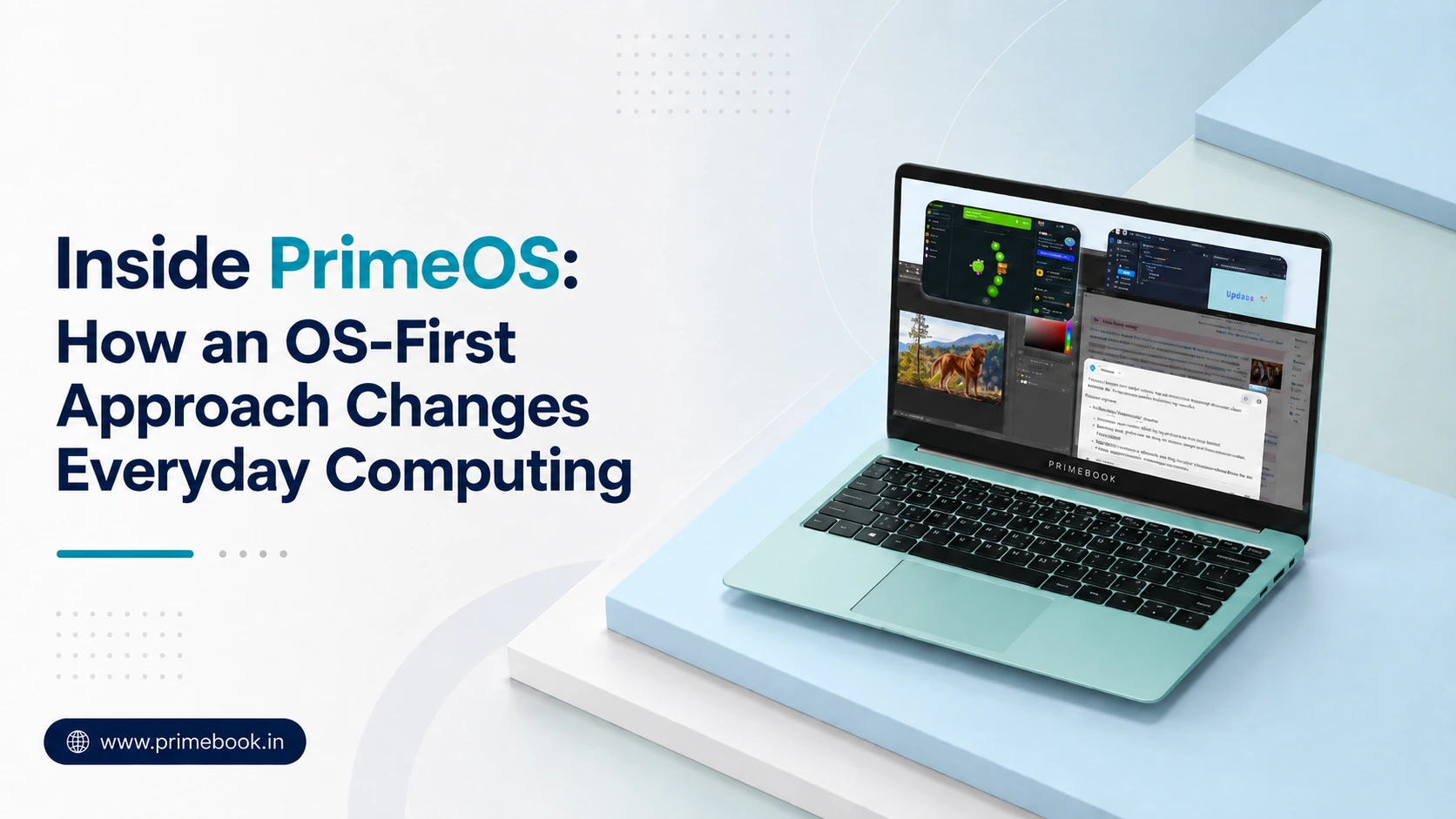
Inside PrimeOS: How an OS-First Approach Changes Everyday Computing
Table of Contents
- Introduction
- Why the OS Layer Decides Real Performance
- An Android Foundation Built for India
- How PrimeOS Behaves Inside Daily Workflows
- Where Hardware-Software Integration Shows Up
- Conclusion
- FAQs
Introduction
Most laptops are sold as a stack of specifications. For many young Indians, the everyday experience is different: lag while switching between a PDF, a YouTube lecture, and a notes app, or a fan that spins louder than the lecturer. The friction sits at the OS layer, not the silicon.
That is the gap that PrimeOS is designed to address. PrimeOS is an Android-based desktop OS designed natively for laptops, where multi-window behaviour, keyboard input, and app handling are built into the system rather than bolted on. The result is a laptop that behaves around how people actually work, not how a spec sheet reads.
Why the OS Layer Decides Real Performance
For everyday computing, perceived performance is influenced as much by the operating system as the hardware itself. PrimeOS incorporates system-level optimisation, where resource allocation, app behaviour, and background processes are managed continuously to improve everyday responsiveness. For users, this translates into smoother multitasking and more consistent battery behaviour rather than improvements that are only visible in benchmark scores.
This is what an OS-first approach means in practice: the operating system is designed to make efficient use of the available hardware, so everyday responsiveness depends as much on software optimisation as on processing power.
An Android Foundation Built for India
Data from StatCounter India shows Android holds over 95% mobile OS share. Young Indians arrive at their first laptop already fluent in Android apps, gestures, and notifications. A Windows-style learning curve is friction layered on top of friction.
PrimeOS sits on that existing fluency. The Prime App Store and native Android compatibility mean the apps a student or creator already uses on their phone work on the laptop, in a multi-window, keyboard-friendly form. The OS is also developed and integrated in India, allowing the software to evolve around the usage patterns, language preferences, and app ecosystem that many Indian users already rely on rather than some imported defaults.
How PrimeOS Behaves Inside Daily Workflows
The OS-first design shows up in small, repeatable moments across the day:
- Multi-window multitasking: a PDF, a browser tab, and a notes app open side by side without the system stuttering.
- Keymapping: touch-first Android apps respond to keyboard controls, useful for note-taking apps and even Android games.
- PrimeCoding: an offline coding environment for beginners with zero setup, removing the install-and-configure barrier.
- Cloud PC access: Linux or Windows environments on demand when a specific workflow needs them, without permanently loading the laptop with a heavy OS.
- Operator AI (PrimeAGNT): a system-level execution layer that completes workflows across apps rather than just answering questions.
Individually, these capabilities solve different everyday problems. Together, they demonstrate how an OS-first approach shapes complete workflows rather than treating features as isolated additions.
Where Hardware-Software Integration Shows Up
Because PrimeOS is developed alongside the hardware it runs on, new system features do not have to wait for third-party operating system updates or generic hardware support. This allows software capabilities such as PrimeCoding, Cloud PC, Operator AI, and future platform features to be integrated directly into the operating system, creating a computing experience that evolves as a unified platform rather than as separate hardware and software products.
The same integration also strengthens the platform from a security perspective. Because the operating system and hardware are designed together, security considerations can be built into the platform from the beginning, helping maintain a more controlled and consistent computing environment as new capabilities are introduced.
This even makes it easier to extend a device's capabilities over time. As new features are developed, they can be introduced through PrimeOS updates rather than requiring users to upgrade their hardware. This means the laptop continues to gain new functionality after purchase, improving its long-term usability and increasing the overall value users receive from their device.
Also Read:
- Windows Vs. PrimeOS: What’s the Difference?
- ChromeOS Vs. PrimeOS: What's the Difference
- Google to Launch Android OS for PCs in 2026: What It Means for Android Laptops?
Conclusion
The success of an operating system is rarely measured by how often people think about it. It is measured by how rarely it interrupts what they are trying to do. As computing becomes more integrated and intelligent, the role of the operating system shifts from being something users actively manage to something that quietly enables work to happen in the background. That may ultimately be the biggest change an OS-first approach brings to everyday computing.
FAQs
Is PrimeOS the same as Android on a phone?
No. PrimeOS is an Android-based desktop OS shaped for laptops, with multi-window support, keyboard navigation, and desktop-style app behaviour built in. The app familiarity carries over from phone, but the workflow does not.
Can I run Windows or Linux apps on a Primebook?
Yes, through the integrated Cloud PC feature. You can access a Windows or Linux environment on demand for specific workflows.
Why does PrimeOS feel smoother on lighter hardware?
Because optimisation happens at the system layer. Resource allocation, background processes, and app behaviour are managed by the OS itself, so the hardware is not asked to compensate for a heavy operating system.
Which Primebook model runs PrimeOS in 2026?
The current 2026 lineup, Primebook 2 Neo, Primebook 2 Pro, and Primebook 2 Max, all ship with PrimeOS. Each is tuned for different screen sizes and workflow intensities while sharing the same OS foundation.
Editorial Transparency: Primebook's editorial team uses a combination of human expertise, research, and AI-powered tools to create and refine content. Every article is reviewed and validated by our team before publication to ensure accuracy, clarity, and usefulness for readers.
 Related Blog